2026, 47(1): 15-31.
doi: 10.21656/1000-0887.460132
Abstract:
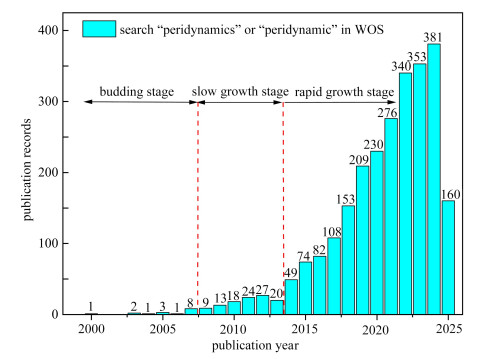
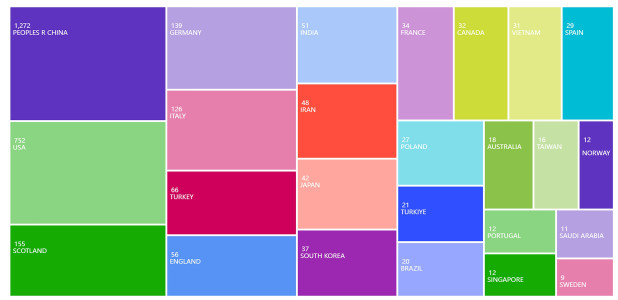
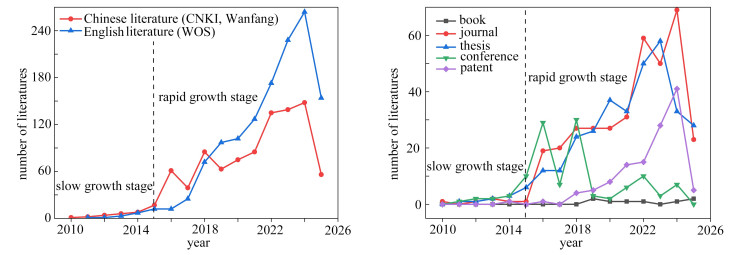
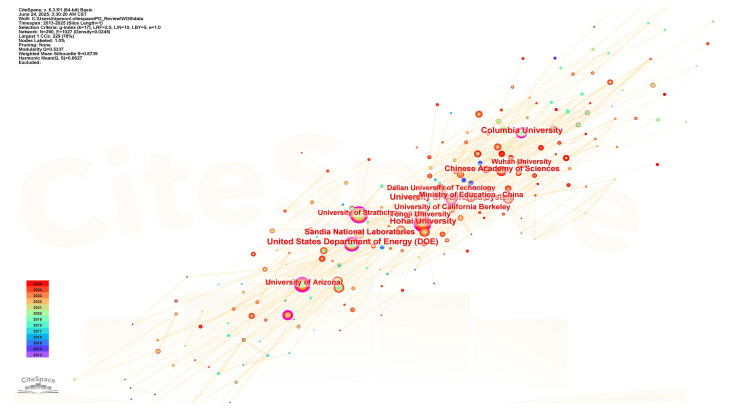
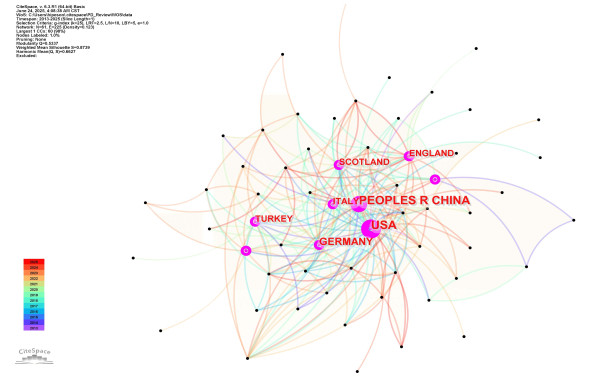
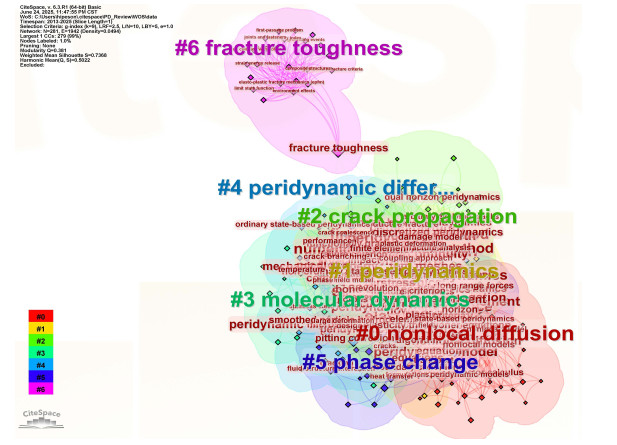
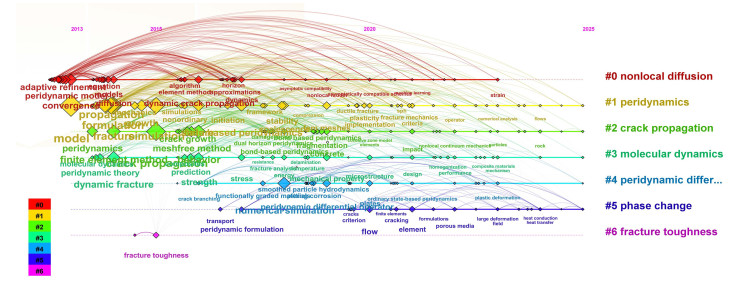
Peridynamics (PD) is a type of integral nonlocal continuum mechanics, originally developed for analyzing damage, fracture, and failure in solids and structures under complex loadings. It has since been extended to diverse problems including diffusion-transport, fluid mechanics, and multi-physics/chemistry couplings (thermal, electrical, magnetic, hygro, chemical). Recent years have witnessed increasingly diversified dimensions, deepening research focus, and broadening applications within the peridynamics field. Based on the bibliometric statistics and visual text-mining tool CiteSpace, PD's development history, current research hotspots, and future trends were reviewed. The research evolution of peridynamics can be categorized into the embryonic, the slow-growth, and the fast-growth periods. Leading contributing nations include China, the United States, the United Kingdom, Germany, Italy, and Türkiye. While the US maintains leadership across multiple domains, China exhibits the fastest growth rate, transitioning from following to paralleling and even leading in specific areas. Key research hotspots encompass PD theoretical modeling, numerical algorithms, dynamic crack propagation and severe fracture in solids, elastic-plastic/large deformation problems, multi-physics couplings (notably thermo-mechanical and fluid-solid), multi-scale and homogenization modeling of heterogeneous materials, coupling PD with other methods (e.g., PD-FEM, PD-SPH, PD-MD, PD-FVM), high-performance computing, and the integration of PD with machine learning. These areas are anticipated to remain central to future research of peridynamics.