


Normalization and Duality Relations of Modified Timoshenko Beams
-
摘要: 为研究修正Timoshenko梁系统的对偶条件和分类,讨论其理论意义. 首先通过引入时间和空间缩放变换,实现了对修正Timoshenko梁动力学方程的标准化;其次,基于该归一化方程,论证了在任意相同边界条件下参数型对偶关系的存在性;然后,探讨了不同截面类型参数型对偶关系的特点;最后,在固支-铰支、固支-固支和固支-自由这三种边界条件下,求解标准化方程,提出了构造对偶梁的方法,并通过文献算例展示了修正Timoshenko梁参数型对偶性的特征. 结果表明:归一化算法求解修正Timoshenko对偶梁的频率完全相同,且基于该算法可论证其修正Timoshenko梁的参数型对偶条件. 动力学特性的参数型对偶关系为修正Timoshenko梁的一种本质属性,时空缩放变换为揭示该特性的有效方法.
-
关键词:
- 修正Timoshenko梁 /
- 对偶关系 /
- 归一化算法 /
- 动力学方程
Abstract: The duality conditions and classification of the modified Timoshenko beam systems were investigated, with its theoretical significance highlighted. First, the modified dynamic equations for the Timoshenko beam were normalized through time and space scaling transformations. Based on the normalized equations, the existence of parametric duality relations was established under arbitrary identical boundary conditions. Next, the parametric dual characteristics corresponding to different cross-sectional geometries were analyzed. Finally, under clamped-hinged, clamped-clamped, and clamped-free boundary conditions, the normalized equations were solved, to develop a novel method for building dual beams. Through examples from the literatures, the parametric dual characteristics of modified Timoshenko beams were further elucidated. The results demonstrate that, the frequencies of the modified Timoshenko dual beams derived via the normalization algorithm are identical, which confirms the parametric dual conditions of the modified beams. This study reveals that the parametric duality of dynamic properties is an intrinsic feature of modified Timoshenko beams, and the time and space scaling transformations provide a robust framework for uncovering these properties.-
Key words:
- modified Timoshenko beam /
- duality relation /
- normalization algorithm /
- dynamic equation
-

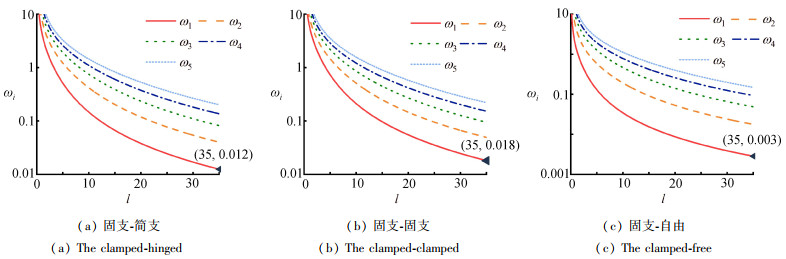
图 2 在不同的边界条件下无量纲频率-梁长(ω-l)曲线
Figure 2. Dimensionless frequency-length (ω-l) curves in different boundary conditions

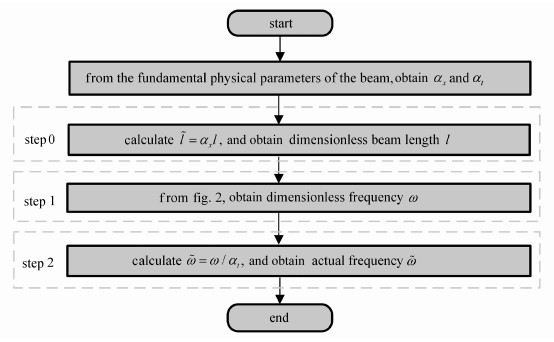
图 3 修正Timoshenko梁的归一化算法流程图
Figure 3. The flow chart of the normalization algorithm for the modified Timoshenko beam

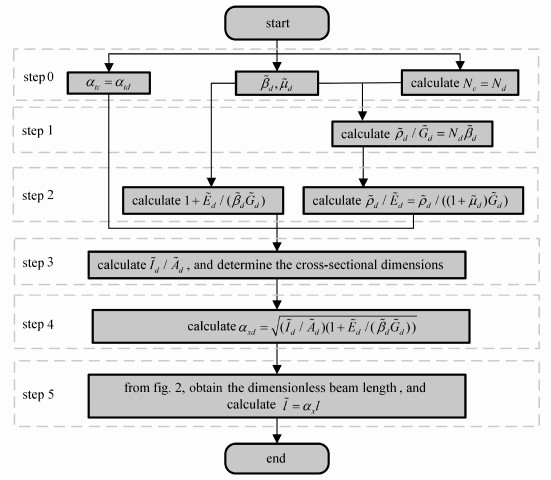
图 4 修正Timoshenko对偶梁的构造流程图
Figure 4. Construction flowchart of the modified Timoshenko dual beam
表 1 不同边界条件下修正Timoshenko梁的频率方程
Table 1. Frequency equations of the modified Timoshenko beam under different boundary conditions
boundary condition end condition frequency equation clamped-hinged φ(0)=0 $\left(\lambda_2-\frac{N \omega^2}{\lambda_2}\right) \tanh \left(\lambda_1 l\right)-\left(\lambda_1+\frac{N \omega^2}{\lambda_1}\right) \tan \left(\lambda_2 l\right)=0$ θ(0)=0 φ(l)=0 θ′(l)=0 clamped-clamped φ(0)=0 $2-2 \cosh \left(\lambda_1 l\right) \cos \left(\lambda_2 l\right)+\left(\frac{\lambda_1+\frac{N \omega^2}{\lambda_1}}{\lambda_2-\frac{N \omega^2}{\lambda_2}}-\frac{\lambda_2-\frac{N \omega^2}{\lambda_2}}{\lambda_1+\frac{N \omega^2}{\lambda_1}}\right) \sinh \left(\lambda_1 l\right) \sin \left(\lambda_2 l\right)=0$ θ(0)=0 φ(l)=0 θ(l)=0 clamped-free φ(0)=0 $2+\left(\frac{\lambda_1}{\lambda_2}-\frac{\lambda_2}{\lambda_1}\right) \sin \left(\lambda_2 l\right) \sinh \left(\lambda_1 l\right)+\left(\frac{\lambda_1}{\lambda_2} \frac{\lambda_1+\frac{N \omega^2}{\lambda_1}}{\lambda_2-\frac{N \omega^2}{\lambda_2}}+\frac{\lambda_2}{\lambda_1} \frac{\lambda_2-\frac{N \omega^2}{\lambda_2}}{\lambda_1+\frac{N \omega^2}{\lambda_1}}\right) \cos \left(\lambda_2 l\right) \cosh \left(\lambda_1 l\right)=0$ θ(0)=0 φ′(l)-θ(l)=0 θ′(l)=0  下载: 导出CSV
表 3 不同边界条件下的修正Timoshenko梁频率
Table 3. Frequencies of modified Timoshenko beams under different boundary conditions
boundary condition i $\widetilde{\omega}_{\mathrm{n}}$/(rad/s) $\widetilde{\omega}_{\mathrm{r}}$[11]/(rad/s) e/% clamped-hinged 1 631.232 630.412 0.13 2 2 018.847 2 014.308 0.23 3 4 125.726 4 112.848 0.31 4 6 864.657 6 838.452 0.38 5 10 135.553 10 091.089 0.44 6 13 837.133 13 769.815 0.49 7 17 875.455 17 782.256 0.52 8 22 168.834 22 047.127 0.55 9 26 649.650 26 498.326 0.57 10 31 264.002 31 082.446 0.58 clamped-clamped 1 915.671 912.938 0.30 2 2 488.636 2 476.375 0.50 3 4 775.607 4 744.422 0.66 4 7 676.644 7 615.902 0.80 5 11 090.608 10 990.008 0.92 6 14 916.089 14 767.862 1.00 7 19 060.313 18 857.965 1.07 8 23 443.475 23 183.168 1.12 9 28 000.130 27 679.656 1.16 10 32 678.554 32 297.026 1.18 clamped-free 1 893.027 6 892.977 0.01 2 5 227.950 2 5 228.583 -0.01 3 13 349.451 4 13 361.775 -0.09 4 23 453.124 4 23 521.191 -0.29 5 34 658.126 3 34 843.732 -0.53 6 46 382.805 5 46 733.804 -0.75 7 58 312.566 9 58 848.124 -0.91 8 70 281.369 7 71 003.211 -1.02 9 82 211.315 8 83 112.545 -1.08 10 94 070.323 5 95 140.946 -1.13
下载: 导出CSV
表 4 对偶梁基本物理参数
Table 4. Basic physical parameters of the dual beams
beam beam dimension/m elastic modulus/GPa density/(kg/m3) shear coefficient Poisson’s ratio shear modulus/GPa ref. [11] $\begin{gathered}\tilde{l} \times \tilde{b} \times \tilde{h}= 2 \times 0.1 \times 0.1\end{gathered}$ 260 8 000 5/6 0.3 100 beam #1 $\begin{gathered}\tilde{l} \times \tilde{b} \times \tilde{h}= 2 \times 0.3 \times 0.1\end{gathered}$ 208 6 400 5/6 0.3 80 beam #2 $\begin{aligned} & \tilde{l}=1.998 ; \\ & \widetilde{D}=0.119\end{aligned}$ 245.029 8 000 9/10 0.3 94.242
下载: 导出CSV
表 5 不同对偶梁的频率
Table 5. The dual beam frequency comparison
beam boundary condition i ω/(rad/s) αt αx $\widetilde{\omega}$/(rad/s) ref. [11] clamped-hinged 1 1.317E-2 2.086E-5 5.859E-2 631.232 2 4.212E-2 2 018.847 3 8.607E-2 4 125.726 4 1.432E-1 6 864.657 beam #1 clamped-hinged 1 1.317E-2 2.086E-5 5.859E-2 631.232 2 4.212E-2 2 018.847 3 8.607E-2 4 125.726 4 1.432E-1 6 864.657 beam #2 clamped-hinged 1 1.317E-2 2.086E-5 5.854E-5 631.232 2 4.212E-2 2 018.847 3 8.607E-2 4 125.726 4 1.432E-1 6 864.657
下载: 导出CSV
-
[1] 周博, 郑雪瑶, 康泽天, 等. 基于修正偶应力理论的Timoshenko微梁模型和尺寸效应研究[J]. 应用数学和力学, 2019, 40(12): 1321-1334. doi: 10.21656/1000-0887.400056ZHOU Bo, ZHENG Xueyao, KANG Zetian, et al. A Timoshenko micro-beam model and its size effects based on the modified couple stress theory[J]. Applied Mathematics and Mechanics, 2019, 40(12): 1321-1334. (in Chinese) doi: 10.21656/1000-0887.400056 [2] 关玉铭, 戈新生. 基于非约束模态的中心刚体-Timoshenko梁动力学建模与分析[J]. 应用数学和力学, 2022, 43(2): 156-165. doi: 10.21656/1000-0887.420089GUAN Yuming, GE Xinsheng. Dynamic modeling and analysis of the central rigid body-Timoshenko beam model based on unconstrained modes[J]. Applied Mathematics and Mechanics, 2022, 43(2): 156-165. (in Chinese) doi: 10.21656/1000-0887.420089 [3] LOVE A E. A Treatise on the Mathematical Theory of Elasticity[M]. New York: Dover, 1927: 314-331. [4] TRAILL-NASH R W, COLLAR A R. The effects of shear flexibility and rotatory inertia on the bending vibrations of beams[J]. The Quarterly Journal of Mechanics and Applied Mathematics, 1953, 6(2): 186-222. doi: 10.1093/qjmam/6.2.186 [5] LUBLINER E, ELISHAKOFF I. Random vibration of system with finitely many degrees of freedom and several coalescent natural frequencies[J]. International Journal of Engineering Science, 1986, 24(4): 461-470. doi: 10.1016/0020-7225(86)90038-8 [6] ELISHAKOFF I. Handbook on Timoshenko-Ehrenfest Beam and Uflyand-Mindlin Plate Theories[M]. New York: Isaac Elishakoff, 2019: 107-138. [7] 余云燕, 孔嘉乐, 陈进浩, 等. 变截面修正Timoshenko梁自振频率的回传射线矩阵法分析[J]. 地震工程学报, 2022, 44(4): 751-758.YU Yunyan, KONG Jiale, CHEN Jinhao, et al. Natural frequency of a modified Timoshenko beam with variable cross-section with the method of reverberation ray matrix[J]. China Earthquake Engineering Journal, 2022, 44(4): 751-758. (in Chinese) [8] LI M L, WEI P J, ZHOU X L. Wave propagation and free vibration of a Timoshenko beam mounted on the viscoelastic Pasternak foundation modeled by fraction-order derivatives[J]. Mechanics of Time-Dependent Materials, 2023, 27(4): 1209-1223. doi: 10.1007/s11043-022-09541-4 [9] 吴晓, 罗佑新. 用Timoshenko梁修正理论研究功能梯度材料梁的动力响应[J]. 振动与冲击, 2011, 30(10): 245-248.WU Xiao, LUO Youxin. Dynamic responses of a beam with functionally graded materials with Timoshenko beam correction theory[J]. Journal of Vibration and Shock, 2011, 30(10): 245-248. (in Chinese) [10] FALSONE G, SETTINERI D, ELISHAKOFF I. A new class of interdependent shape polynomials for the FE dynamic analysis of Mindlin plate Timoshenko beam[J]. Meccanica, 2015, 50(3): 767-780. doi: 10.1007/s11012-014-0032-9 [11] ELISHAKOFF I, TONZANI G M, MARZANI A. Effect of boundary conditions in three alternative models of Timoshenko-Ehrenfest beams on Winkler elastic foundation[J]. Acta Mechanica, 2018, 229(4): 1649-1686. doi: 10.1007/s00707-017-2034-x [12] ELISHAKOFF I, TONZANI G M, MARZANI A. Three alternative versions of Bresse-Timoshenko theory for beam on pure Pasternak foundation[J]. International Journal of Mechanical Sciences, 2018, 149: 402-412. doi: 10.1016/j.ijmecsci.2017.10.043 [13] KARNOPP B H. Duality relations in the analysis of beam oscillations[J]. Zeitschrift für Angewandte Mathematik und Physik ZAMP, 1967, 18(4): 575-580. [14] CHEN Q, ZHU D. Vibrational analysis theory and application to elastic-viscoelastic composite structures[J]. Computers & Structures, 1990, 37(4): 585-595. [15] RAM Y M, ELHAY S. Dualities in vibrating rods and beams: continuous and discrete models[J]. Journal of Sound and Vibration, 1995, 184(5): 759-766. doi: 10.1006/jsvi.1995.0345 [16] LI X, XU F, ZHANG Z. Symplectic method for natural modes of beams resting on elastic foundations[J]. Journal of Engineering Mechanics, 2018, 144(4): 04018009. doi: 10.1061/(ASCE)EM.1943-7889.0001427 [17] 胡海岩. 梁在固有振动中的对偶关系[J]. 力学学报, 2020, 52(1): 139-149.HU Haiyan. Duality relations of beams in natural vibrations[J]. Chinese Journal of Theoretical and Applied Mechanics, 2020, 52(1): 139-149. (in Chinese) [18] ELISHAKOFF I, AMATO M. Flutter of a beam in supersonic flow: truncated version of Timoshenko-Ehrenfest equation is sufficient[J]. International Journal of Mechanics and Materials in Design, 2021, 17(4): 783-799. doi: 10.1007/s10999-021-09537-x -

计量
- 文章访问数: 131
- HTML全文浏览量: 33
- PDF下载量: 24
- 被引次数: 0

 渝公网安备50010802005915号