


A Generalized Multiscale Iterative Finite Element Method for Parameterized Dual-Continuum Models
-
摘要: 含参双重连续介质模型在地下地层相关的多种应用建模中具有重要的理论意义与实际价值. 该模型能够有效描述地质体中高度非均质性、强对比度的多尺度结构特征,并体现出显著的不确定性. 针对此类复杂模型的数值求解,采用合适的降阶方法已成为提升计算效率与保持求解精度的关键手段. 本文针对含参双重连续介质模型,提出了一种基于广义多尺度有限元方法的迭代求解策略. 该方法首先将原始的参数依赖型双重介质模型重新表述为一个包含多尺度扩散系数和转移函数(均与参数无关)以及参数相关右端项的新模型. 在此基础上,所提出的迭代方法划分为离线与在线两个阶段. 在离线阶段,本文在每个粗网格区域内,根据确定性多尺度参数构造多尺度基函数,并生成相应的降阶空间;在在线阶段,利用构建好的降阶空间,通过迭代方法对模型进行高效求解. 该方法的显著优势在于,离线阶段构造完成后,在线阶段每次迭代均可使用高效的直接求解器,并能重复利用矩阵逆,从而显著降低计算成本. 此外,本文还给出了该迭代方法的收敛性分析. 最后,通过参数依赖的双重连续介质模型的数值算例,验证了所提出方法的有效性与计算效率,并进一步验证了理论收敛结果的正确性.
-
关键词:
- 双重连续介质模型 /
- 广义多尺度有限元方法 /
- 迭代方法 /
- 不确定性量化
Abstract: The parameterized dual-continuum model plays a significant theoretical and practical role in various subsurface geological modeling applications. This model effectively captures the highly heterogeneous, high-contrast, and multiscale structural features of geological formations, while also exhibiting considerable uncertainty. To address the numerical challenges posed by such complex models, adopting appropriate model reduction techniques has become a key approach to improving computational efficiency while maintaining solution accuracy. Herein an iterative solution strategy was proposed based on the uncoupled generalized multiscale finite element method (GMsFEM) for the parameterized dual-continuum model. The original parameter-dependent model was reformulated as a new one consisting of multiscale diffusion coefficients and transfer functions (both parameter-independent), along with a parameter-dependent source term. The proposed iterative method was divided into offline and online stages. In the offline stage, multiscale basis functions were constructed in each coarse grid block based on deterministic multiscale parameters to generate a reduced-order space. In the online stage, the model was solved efficiently within the reduced space with an iterative scheme. A major advantage of this method lies in the fact that, once the multiscale basis space is constructed offline, each online iteration can leverage efficient direct solvers and reuse matrix inverses, thus significantly reducing computational costs. Furthermore, the convergence of the proposed iterative method was analyzed. Finally, numerical experiments on the parameterized dual-continuum model were conducted to demonstrate the effectiveness and efficiency of the multiscale-based iterative approach, and validate the theoretical convergence results. -

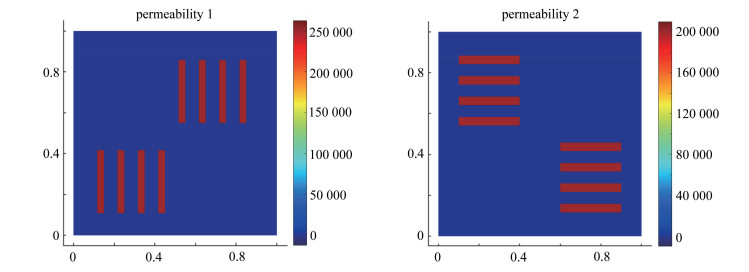
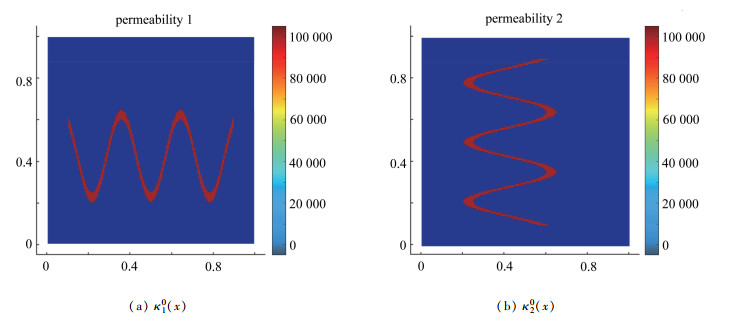
图 2 高震荡渗透率场κ10(x)(左)和κ20(x)(右)
Figure 2. High-contrast coefficients κ10(x) (left) and κ20(x) (right)

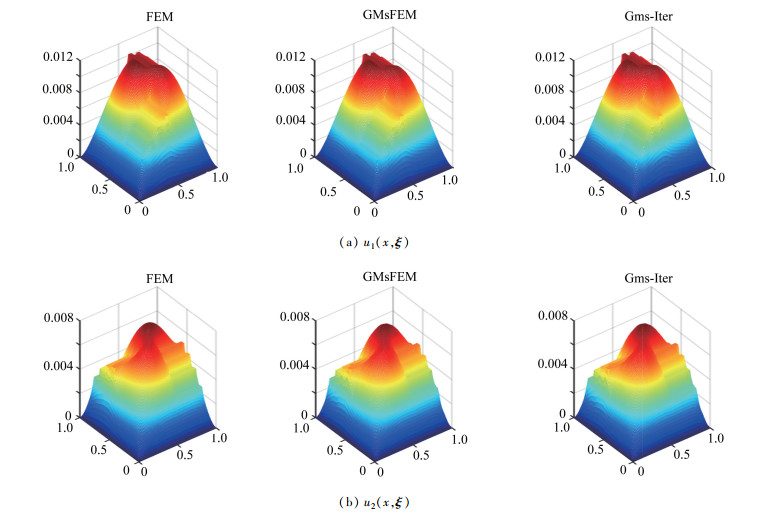
图 3 不同数值模拟方法计算得到的均值轮廓图
Figure 3. Mean profiles obtained with different numerical simulation methods

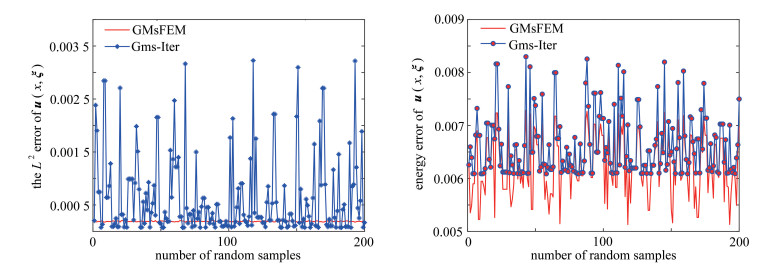
图 4 变量u(x; ξ)在200个随机样本处的相对误差
Figure 4. The relative errors of variable u(x; ξ) based on 200 random samples

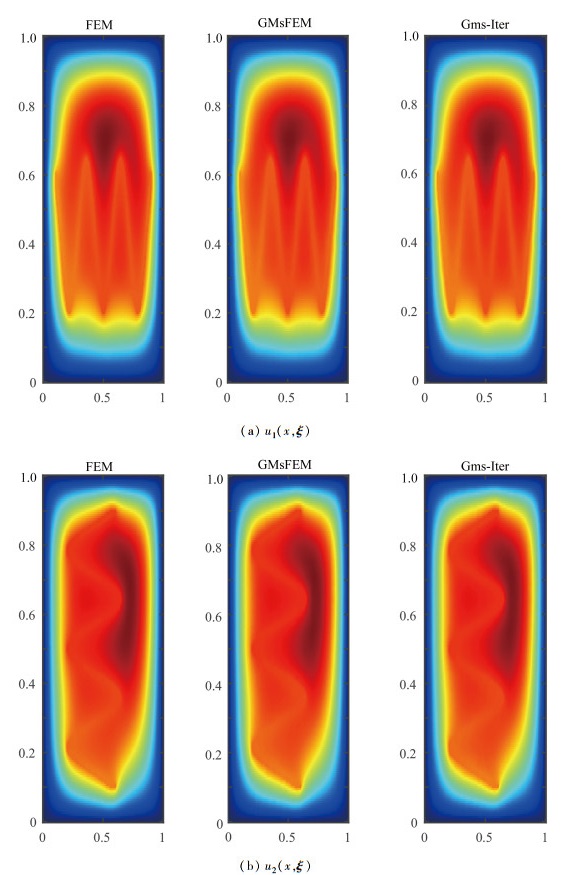
图 7 双重连续问题的参考解和数值解
Figure 7. The reference solutions and numerical solutions of the dual-continuum problem
表 1 不同粗网格大小H下,变量u(x; ξ)在L2范数意义下的相对误差
Table 1. The relative L2 errors with different coarse mesh sizes H for u(x; ξ)
relative error H=1/2 H=1/4 H=1/6 H=1/8 H=1/10 H=1/12 H=1/24 eugms 6.996 8E-1 4.820 2E-1 3.099 6E-1 1.124 4E-1 2.844 9E-4 1.913 1E-4 1.208 5E-5 euGms-Iter 2.873 3E-1 2.243 0E-1 1.983 5E-1 1.615 3E-1 5.824 6E-3 6.213 6E-3 1.245 7E-3  下载: 导出CSV
表 2 不同粗网格大小下,变量u(x; ξ)在能量范数下的相对误差
Table 2. The relative energy errors with different coarse mesh sizes H for u(x; ξ)
relative error H=1/2 H=1/4 H=1/6 H=1/8 H=1/10 H=1/12 H=1/24 eugms 2.492 0E-1 1.662 1E-1 1.415 8E-1 1.278 9E-1 6.701 0E-4 7.189 8E-4 4.979 2E-4 euGms-Iter 2.873 9E-1 2.244 5E-1 1.985 4E-1 1.617 6E-1 6.247 9E-3 6.636 7E-3 1.675 9E-3
下载: 导出CSV
表 3 使用5个基函数的收敛性
Table 3. Convergences with 5 local basis functions
$\underline{\boldsymbol{\kappa}}_1^0(x)$ $\underline{\boldsymbol{\kappa}}_2^0(x)$ ep1, Gms-Iter ep2, Gms-Iter aQGms-Iter 1 1 1.747 0E101 3.970 0E105 1.644E107 3 3 3.670 3E52 9.801 2E57 4.323E59 10 10 2.409 0E-1 8.186 6E5 3.872 2E7 15 15 4.105 7E-3 1.338 5E-2 1.032E-2 20 20 2.822 0E-3 8.364 3E-3 8.832E-3
下载: 导出CSV
表 4 基于L2范数意义的收敛结果
Table 4. Convergences based on the L2-norm
H eugms order euGms-Iter order 1/2 6.079 4E-1 - 6.789 1 - 1/4 4.991 3E-1 0.284 5 5.535 8 0.294 4 1/8 2.991 3E-2 2.172 5 2.577 4E-2 4.020 6 1/16 2.366 1E-5 4.883 0 4.999 8E-3 3.469 0 1/32 4.960 3E-6 4.225 8 5.509 3E-3 2.566 8
下载: 导出CSV
表 5 基于能量范数意义的收敛结果
Table 5. Convergences based on the energy norm
H eugms order euGms-Iter order 1/2 6.648 8E-1 - 6.650 4E-1 - 1/4 5.821 0E-1 0.191 8 5.823 0E-1 0.191 7 1/8 5.419 5E-2 1.743 9 5.465 2E-2 3.478 4 1/16 3.546 3E-3 2.516 9 4.017 8E-3 2.457 0 1/32 1.680 7E-3 2.157 0 2.152 8E-3 2.067 8
下载: 导出CSV
-
[1] Yao J, Huang Z Q. Fractured Vuggy Carbonate Reservoir Simulation[M]. 2nd ed. Springer, 2017. [2] Biermans M B G M, Dijkema K M, De Vries D A. Water movement in porous media towards an ice front[J]. Journal of Hydrology, 1978, 37 (1/2): 137-148. [3] Harris C C. Sedimentation rates, fluidization and flow through porous media[J]. Nature, 1959, 184 (4687): 716. doi: 10.1038/184716a0 [4] 李树光, 曲凯. 多孔介质中单相气体局部流动的均质化建模[J]. 应用数学和力学, 2024, 45 (2): 175-183. doi: 10.21656/1000-0887.440246Li Shuguang, Qu Kai. Homogenization modeling of single-phase gas local flow in porous media[J]. Applied Mathematics and Mechanics, 2024, 45 (2): 175-183. (in Chinese) doi: 10.21656/1000-0887.440246 [5] 苏成, 罗俊哲, 许秩. 多孔结构多尺度随机振动分析的渐近均匀化-时域显式法[J]. 应用数学和力学, 2023, 44 (1): 1-11. doi: 10.21656/1000-0887.430116Su Cheng, Luo Junzhe, Xu Zhi. An asymptotic-homogenization explicit time-domain method for random multiscale vibration analysis of porous material structures[J]. Applied Mathematics and Mechanics, 2023, 44 (1): 1-11. (in Chinese) doi: 10.21656/1000-0887.430116 [6] Han J H, Wang M, Bai P, et al. Dendrite suppression by shock electrodeposition in charged porous media[J]. Scientific Reports, 2016, 6: 28054. doi: 10.1038/srep28054 [7] Hayat T, Hussain Z, Alsaedi A, et al. Numerical study for slip flow of carbon-water nanofluids[J]. Computer Methods in Applied Mechanics and Engineering, 2017, 319: 366-378. doi: 10.1016/j.cma.2017.02.021 [8] Baca R G, Arnett R C, Langford D W. Modelling fluid flow in fractured-porous rock masses by finite-element techniques[J]. International Journal for Numerical Methods in Fluids, 1984, 4 (4): 337-348. doi: 10.1002/fld.1650040404 [9] Eikemo B, Lie K A, Eigestad G T, et al. Discontinuous Galerkin methods for advective transport in single-continuum models of fractured media[J]. Advances in Water Resources, 2009, 32 (4): 493-506. doi: 10.1016/j.advwatres.2008.12.010 [10] Bogdanov II, Mourzenko V V, Thovert J F, et al. Two-phase flow through fractured porous media[J]. Physical Review E, 2003, 68 (2): 026703. doi: 10.1103/PhysRevE.68.026703 [11] Granet S, Fabrie P, Lemonnier P, et al. A two-phase flow simulation of a fractured reservoir using a new fissure element method[J]. Journal of Petroleum Science and Engineering, 2001, 32 (1): 35-52. doi: 10.1016/S0920-4105(01)00146-2 [12] Geiger S, Matthäi S, Niessner J, et al. Black-oil simulations for three-component, three-phase flow in fractured porous media[J]. SPE Journal, 2009, 14 (2): 338-354. doi: 10.2118/107485-PA [13] Matthai S K, Mezentsev A A, Belayneh M. Finite element-node-centered finite-volume two-phase-flow experiments with fractured rock represented by unstructured hybrid-element meshes[J]. SPE Reservoir Evaluation & Engineering, 2007, 10 (6): 740-756. [14] Barenblatt G I, Zheltov I P, Kochina I N. Basic concepts in the theory of seepage of homogeneous liquids in fissured rocks[strata] [J]. Journal of Applied Mathematics and Mechanics, 1960, 24 (5): 1286-1303. doi: 10.1016/0021-8928(60)90107-6 [15] Wu Y S, Pruess K. A multiple-porosity method for simulation of naturally fractured petroleum reservoirs[J]. SPE Reservoir Engineering, 1988, 3 (1): 327-336. doi: 10.2118/15129-PA [16] Yan B, Alfi M, An C, et al. General multi-porosity simulation for fractured reservoir modeling[J]. Journal of Natural Gas Science and Engineering, 2016, 33: 777-791. doi: 10.1016/j.jngse.2016.06.016 [17] Akkutlu I Y, Efendiev Y, Vasilyeva M, et al. Multiscale model reduction for shale gas transport in a coupled discrete fracture and dual-continuum porous media[J]. Journal of Natural Gas Science and Engineering, 2017, 48: 65-76. doi: 10.1016/j.jngse.2017.02.040 [18] Cheung S W, Chung E T, Efendiev Y, et al. Constraint energy minimizing generalized multiscale finite element method for dual continuum model[J]. Communications in Mathematical Sciences, 2020, 18 (3): 663-685. doi: 10.4310/CMS.2020.v18.n3.a4 [19] Chung E T, Efendiev Y, Leung T, et al. Coupling of multiscale and multi-continuum approaches[J]. GEM-International Journal on Geomathematics, 2017, 8 (1): 9-41. doi: 10.1007/s13137-017-0093-8 [20] Chung E T, Efendiev Y, Leung W T, et al. Non-local multi-continua upscaling for flows in heterogeneous fractured media[J]. Journal of Computational Physics, 2018, 372: 22-34. doi: 10.1016/j.jcp.2018.05.038 [21] Li Q, Wang Y, Vasilyeva M. Multiscale model reduction for fluid infiltration simulation through dual-continuum porous media with localized uncertainties[J]. Journal of Computational and Applied Mathematics, 2018, 336: 127-146. doi: 10.1016/j.cam.2017.12.040 [22] Park J S R, Cheung S W, Mai T, et al. Multiscale simulations for upscaled multi-continuum flows[J]. Journal of Computational and Applied Mathematics, 2020, 374: 112782. doi: 10.1016/j.cam.2020.112782 [23] Tene M, Al Kobaisi M S, Hajibeygi H. Algebraic multiscale method for flow in heterogeneous porous media with embedded discrete fractures (F-AMS)[J]. Journal of Computational Physics, 2016, 321: 819-845. doi: 10.1016/j.jcp.2016.06.012 [24] Chung E, Efendiev Y, Hou T Y. Adaptive multiscale model reduction with generalized multiscale finite element methods[J]. Journal of Computational Physics, 2016, 320: 69-95. doi: 10.1016/j.jcp.2016.04.054 [25] Efendiev Y, Galvis J, Hou T Y. Generalized multiscale finite element methods (GMsFEM)[J]. Journal of Computational Physics, 2013, 251: 116-135. doi: 10.1016/j.jcp.2013.04.045 [26] Chung E, Efendiev Y, Leung W T. Constraint energy minimizing generalized multiscale finite element method in the mixed formulation[J]. Computational Geosciences, 2018, 22 (3): 677-693. doi: 10.1007/s10596-018-9719-7 [27] Galvis J, Efendiev Y. Domain decomposition preconditioners for multiscale flows in high-contrast media[J]. Multiscale Modeling & Simulation, 2010, 8 (4): 1461-1483. [28] Kim H H, Chung E, Wang J. BDDC and FETI-DP preconditioners with adaptive coarse spaces for three-dimensional elliptic problems with oscillatory and high contrast coefficients[J]. Journal of Computational Physics, 2017, 349: 191-214. doi: 10.1016/j.jcp.2017.08.003 [29] Li G. On the convergence rates of GMsFEMs for heterogeneous elliptic problems without oversampling techniques[J]. Multiscale Modeling & Simulation, 2019, 17 (2): 593-619. [30] Xiao D, Fang F, Pain C C, et al. A parameterized non-intrusive reduced order model and error analysis for general time-dependent nonlinear partial differential equations and its applications[J]. Computer Methods in Applied Mechanics and Engineering, 2017, 317: 868-889. doi: 10.1016/j.cma.2016.12.033 [31] Brunton S L, Kutz J N. Data-driven Science and Engineering: Machine Learning, DynamicalSystems, and Control[M]. 2nd ed. Cambridge: Cambridge University Press, 2022. [32] Hesthaven J S, Rozza G, Stamm B. Certified Reduced Basis Methods for Parametrized Partial Differential Equations[M]. Springer, 2016. [33] Quarteroni A, Manzoni A, Negri F. Reduced Basis Methods for Partial Differential Equations: an Introduction[M]. Springer, 2016. [34] 王青山, 严波, 陈岩, 等. 基于降阶模型和数据驱动的动态结构数字孪生方法[J]. 应用数学和力学, 2023, 44 (7), 757-768. doi: 10.21656/1000-0887.430384Wang Qingshan, Yan Bo, Chen Yan, et al. A digital twin method for dynamic structures based on reduced order models and data driving[J]. Applied Mathematics and Mechanics, 2023, 44 (7), 757-768. (in Chinese) doi: 10.21656/1000-0887.430384 [35] Gunzburger M, Jiang N, Schneier M. An ensemble-proper orthogonal decomposition method for the nonstationary Navier-Stokes equations[J]. SIAM Journal on Numerical Analysis, 2017, 55 (1): 286-304. doi: 10.1137/16M1056444 [36] Luo Y, Wang Z. A multilevel Monte Carlo ensemble scheme for random parabolic PDEs[J]. SIAM Journal on Scientific Computing, 2019, 41 (1): A622-A642. doi: 10.1137/18M1174635 [37] Gunzburger M, Jiang N, Wang Z. An efficient algorithm for simulating ensembles of parameterized flow problems[J]. IMA Journal of Numerical Analysis, 2019, 39 (3): 1180-1205. doi: 10.1093/imanum/dry029 [38] Feng X, Lin J, Lorton C. An efficient numerical method for acoustic wave scattering in random media[J]. ASA Journal on Uncertainty Quantification, 2015, 3 (1): 790-822. [39] Feng X, Lin J, Lorton C. A multimodes Monte Carlo finite element method for elliptic partial differential equations with random coefficients[J]. International Journal for Uncertainty Quantification, 2016, 6 (5): 429-443. doi: 10.1615/Int.J.UncertaintyQuantification.2016016805 [40] Zhang S, Yang Z, Guan X. Multi-modes multiscale approach of heat transfer problems in heterogeneous solids with uncertain thermal conductivity[J]. Advances in Applied Mathematics and Mechanics, 2025, 15 (1): 69-93. [41] Feng X, Luo Y, Vo L, et al. An efficient iterative method for solving parameter-dependent and random convection-diffusion problems[J]. Journal of Scientific Computing, 2022, 90: 72. doi: 10.1007/s10915-021-01737-z -

计量
- 文章访问数: 36
- HTML全文浏览量: 14
- PDF下载量: 9
- 被引次数: 0

 渝公网安备50010802005915号