


Solving Equations With Discontinuous Solutions Based on the AGA-PINNs Method
-
摘要: 物理信息神经网络(physics-informed neural networks, PINNs)是求解偏微分方程的重要工具,在偏微分方程的数值求解中,具有间断解的方程是目前的研究难题,PINNs及其现有的改进算法通常无法捕捉到间断的特性,然而在流体力学领域需要考虑许多间断问题. 针对PINNs处理具有间断解的方程的不足,本文提出了自适应梯度消灭的物理信息神经网络(adaptive gradient-annihilated PINNs, AGA-PINNs)方法来求解具有间断解的Burgers方程与Allen-Cahn方程. 该方法利用与梯度相关的权重函数来优化损失函数,并在训练过程中根据当前的残差分布动态调整训练点,以逐步强化模型对间断区域的学习能力. 算例结果表明,AGA-PINNs方法比传统的PINNs方法、gPINNs方法、GA-PINNs方法、高阶DG方法等对于物理量的预测精度有显著提升,在求解Burgers方程与Allen-Cahn方程时均方误差降低了大约一个数量级,准确地再现了Burgers方程中冲击波的特征与Allen-Cahn方程中相分离现象.
-
关键词:
- AGA-PINNs /
- Burgers方程 /
- Allen-Cahn方程 /
- 自适应方法
Abstract: The physical information neural networks (PINNs) are an important tool for solving partial differential equations. In the numerical solution of partial differential equations, equations with discontinuous solutions are currently a research challenge. The PINNs and their existing improved algorithms often cannot capture the characteristics of discontinuities. However, many discontinuous problems need to be considered in the field of fluid mechanics. In response to the shortcomings of the PINNs in handling equations with discontinuous solutions, an adaptive gradient-annihilated PINNs (AGA-PINNs) method was proposed to solve the Burgers equations and the Allen-Cahn equations with discontinuous solutions. The gradient related weight functions were utilized to optimize the loss function, and the training points were dynamically adjusted based on the current residual distribution during the training process to gradually enhance the model's learning ability in discontinuous regions. The experimental results show that, the AGA-PINNs method significantly improves the accuracy of predicted physical quantities compared to the traditional PINNs, the gradient-enhanced physics-informed neural networks (gPINNs), the gradient-annihilated physics-informed neural networks (GA-PINNs) method, and the high-order deep Galerkin (DG)method. In solving the Burgers equation and the Allen-Cahn equation, the mean square errors decrease by approximately 1 order of magnitude, accurately reproducing the characteristics of shock waves in the Burgers equation and the phase separation phenomena in the Allen-Cahn equation.-
Key words:
- AGA-PINNs /
- Burgers equation /
- Allen-Cahn equation /
- adaptive method
-

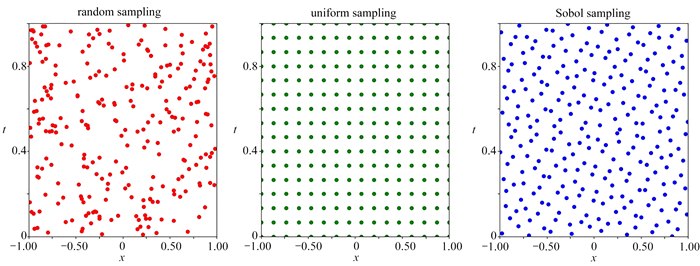
图 2 不同采样方法生成256个训练点的可视化结果
Figure 2. Visualization results of 256 training points generated with different sampling methods

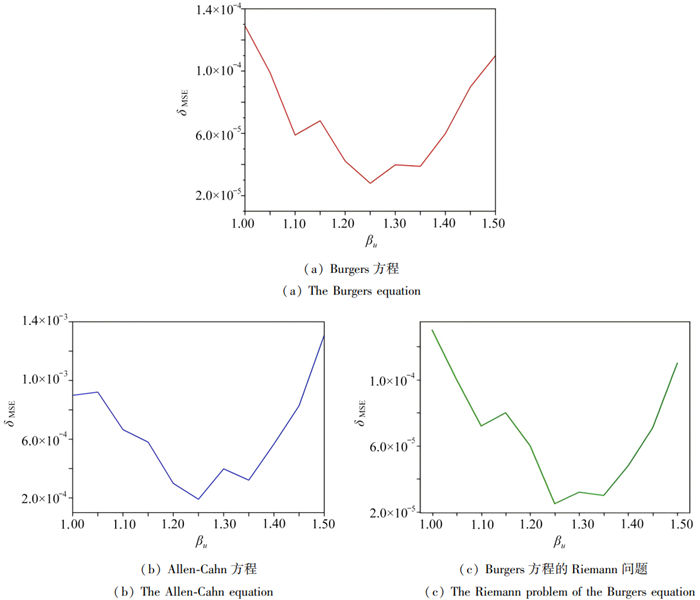
图 3 不同βu值时AGA-PINNs预测物理量的均方误差
Figure 3. δMSE of predicting physical quantities using AGA-PINNs with different βu values

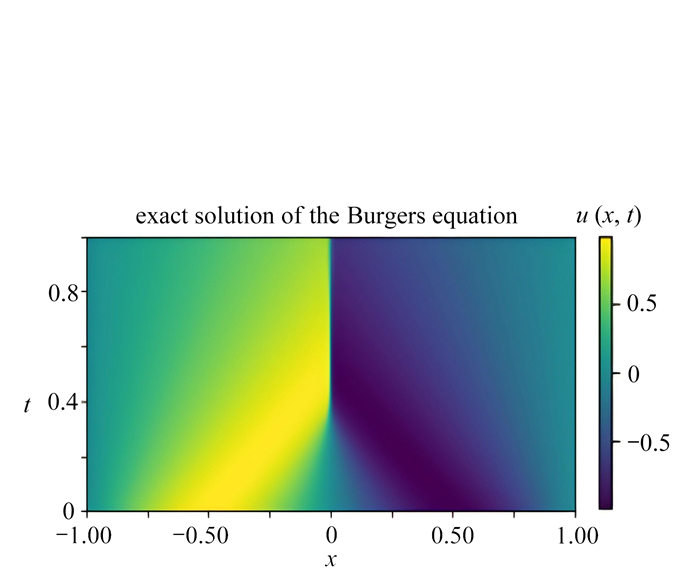
图 4 Burgers方程精确解
注 为了解释图中的颜色,读者可以参考本文的电子网页版本,后同.
Figure 4. The exact solution of the Burgers equation

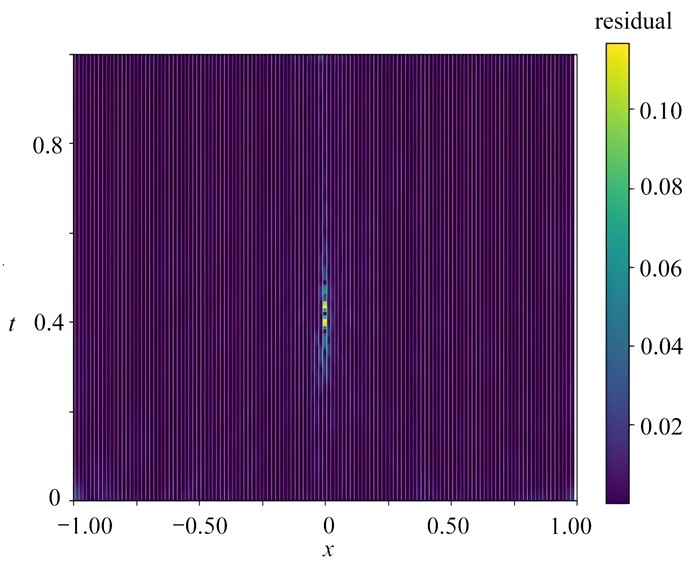
图 5 求解Burgers方程初始训练后PDE残差
注 为了解释图中的颜色,读者可以参考本文的电子网页版本,后同.
Figure 5. PDE residuals after initial training in solving the Burgers equation

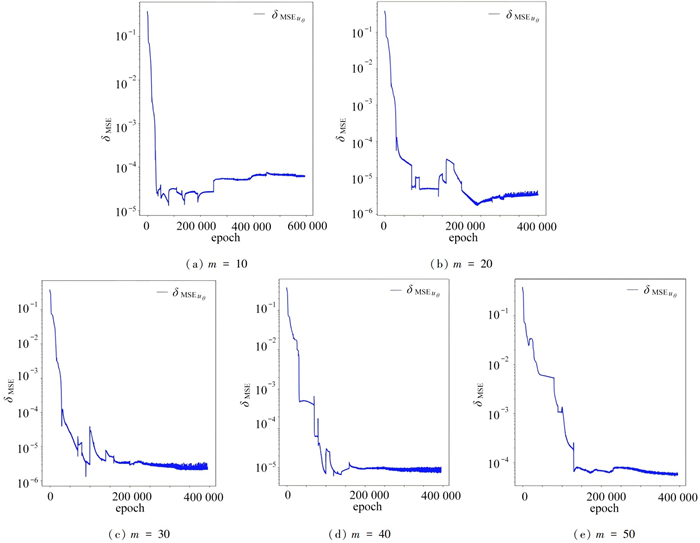
图 6 不同m值AGA-PINNs求解Burgers方程均方误差
Figure 6. δMSE in solving the Burgers equation using AGA PINNs with different m values

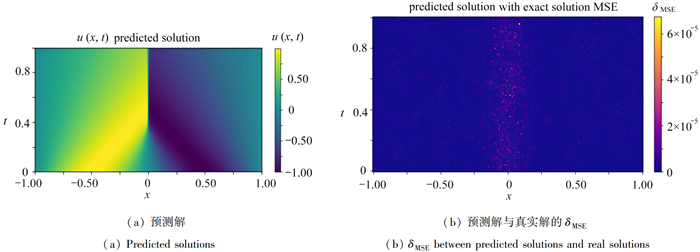
图 7 m=30时AGA-PINNs求解Burgers方程预测结果
Figure 7. Predicting results of AGA-PINNs with m=30 for solving Burgers equation

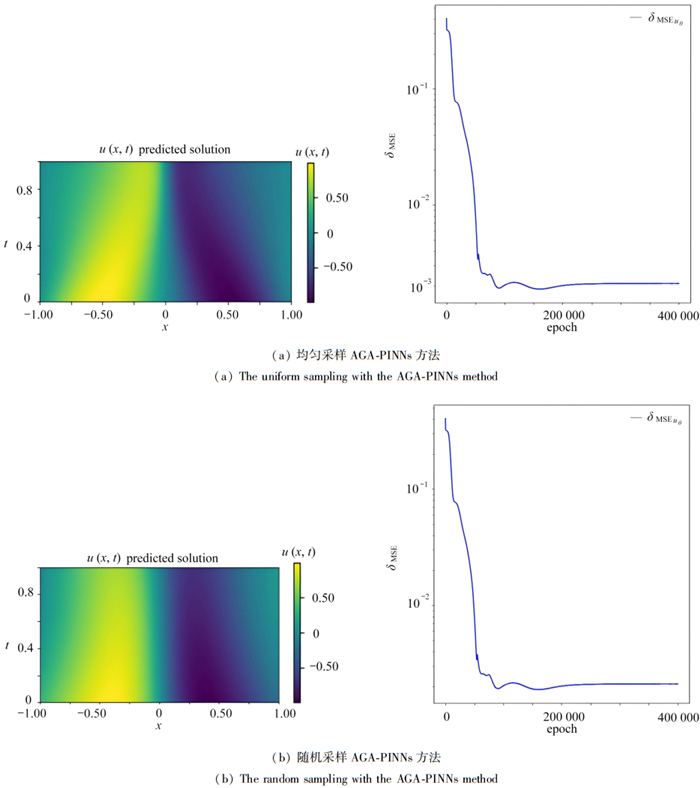
图 8 不同采样方法AGA-PINNs求解Burgers方程预测结果
Figure 8. Predicted results of the Burgers equation using the AGA-PINNs with different sampling methods

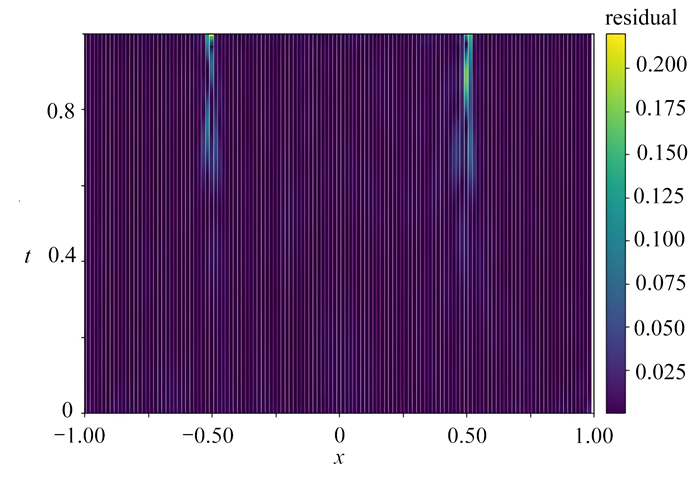
图 10 求解Allen-Cahn方程初始训练后PDE残差
Figure 10. PDE residuals after initial training in solving the Allen-Cahn equation

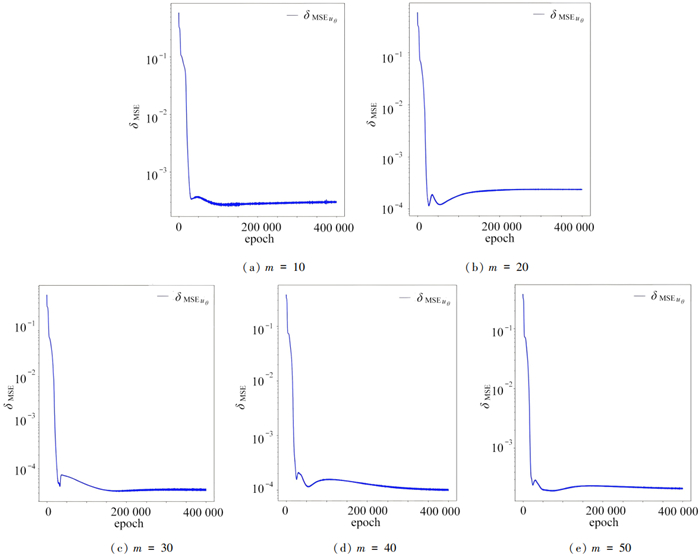
图 11 不同m值AGA-PINNs求解Allen-Cahn方程均方误差
Figure 11. δMSE in solving the Allen-Cahn equation using the AGA-PINNs with different m values

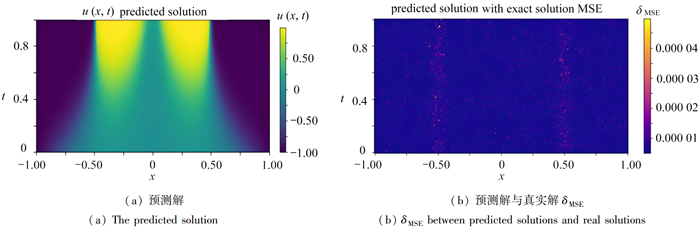
图 12 m=30时AGA-PINNs求解Allen-Cahn方程预测结果
Figure 12. Predicted results with the AGA-PINNs for m=30 in solving the Allen-Cahn equation

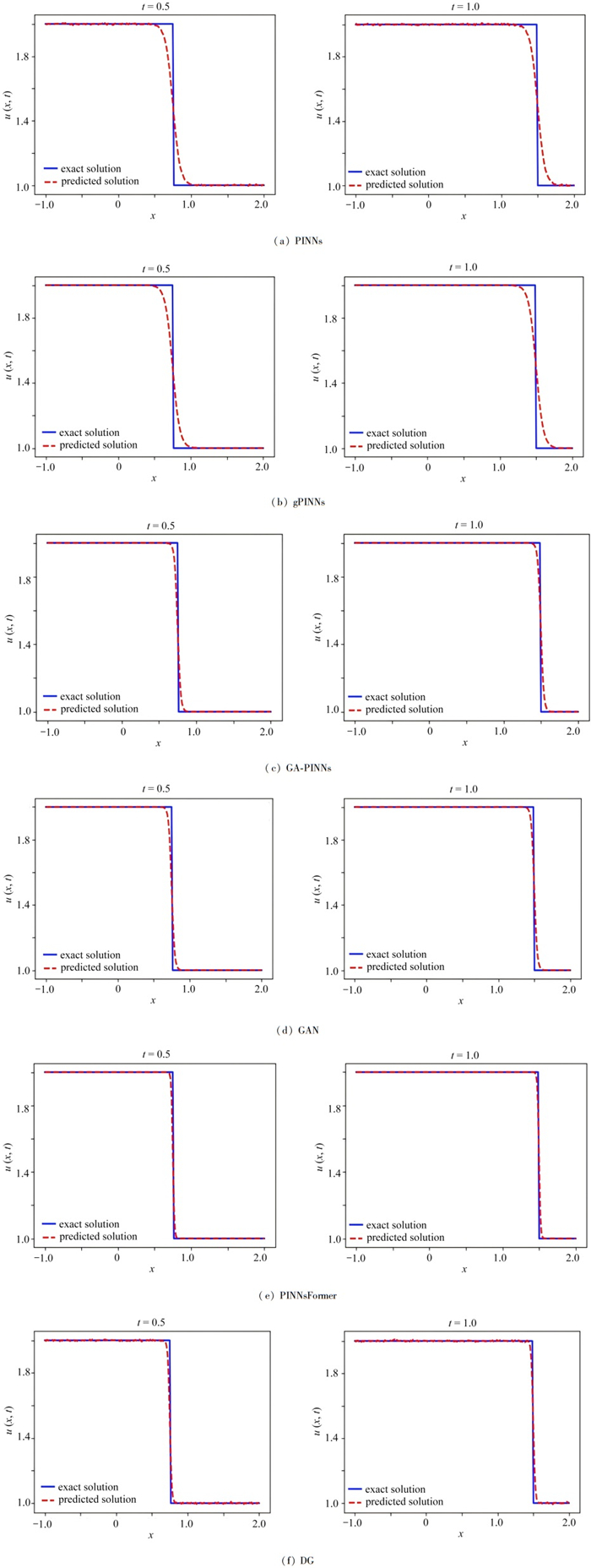
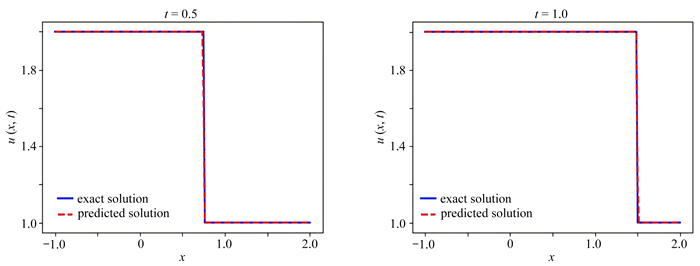
图 13 不同方法求解Burgers方程的Riemann问题的预测结果
Figure 13. Prediction results of the Burgers equation for the Riemann problem solved with different methods

图 14 m=30时AGA-PINNs求解Bugers方程的Riemann问题的预测结果
Figure 14. Predicting results of AGA-PINNs for m=30 in solving the Burgers equation of the Riemann problem
表 1 不同方法求解Burgers方程损失及δMSE
Table 1. Losses and δMSE in solving the Burgers equation with different methods
method loss δMSE GA-PINNs 1.06×10⁻⁶ 6.23×10⁻⁵ PINNs 1.49×10⁻⁵ 8.10×10⁻⁴ gPINNs 7.48×10⁻⁵ 6.01×10⁻³ GAN 4.82×10⁻⁶ 9.17×10⁻⁵ PINNsFormer 9.58×10⁻⁶ 2.62×10⁻⁴ high-order DG - 7.99×10⁻⁵  下载: 导出CSV
表 2 不同m值AGA-PINNs求解Burgers方程损失及δMSE
Table 2. Losses and δMSE in solving the Burgers equation with the AGA-PINNs for different m values
number of adaptive points loss δMSE 10 1.08×10⁻⁶ 7.13×10⁻⁵ 20 6.06×10⁻⁷ 3.19×10⁻⁶ 30 3.71×10⁻⁷ 1.31×10⁻⁶ 40 8.98×10⁻⁷ 8.02×10⁻⁶ 50 1.03×10⁻⁶ 5.55×10⁻⁵
下载: 导出CSV
表 3 不同方法求解Allen-Cahn方程损失及δMSE
Table 3. Losses and δMSE in solving the Allen-Cahn equation with different methods
method loss δMSE GA-PINNs 9.18×10⁻⁶ 7.88×10⁻⁴ PINNs 8.23×10⁻⁵ 2.37×10⁻³ gPINNs 1.75×10⁻⁵ 8.05×10⁻⁴ GAN 1.92×10⁻⁵ 9.39×10⁻⁴ PINNsFormer 6.46×10⁻⁵ 1.69×10⁻³ high-order DG - 3.22×10⁻⁴
下载: 导出CSV
表 4 不同m值AGA-PINNs求解Allen-Cahn方程损失及δMSE
Table 4. Losses and δMSE in solving the Allen-Cahn equation with the AGA-PINNs for different m values
number of adaptive points loss δMSE 10 1.88×10⁻⁶ 3.19×10⁻⁴ 20 8.96×10⁻⁷ 2.57×10⁻⁴ 30 2.02×10⁻⁷ 3.52×10⁻⁵ 40 6.47×10⁻⁷ 1.01×10⁻⁴ 50 9.25×10⁻⁷ 2.41×10⁻⁴
下载: 导出CSV
表 5 不同m值AGA-PINNs求解Burgers方程的Riemann问题的损失及δMSE
Table 5. Losses and δMSE in solving the Burgers equation of the Riemann problem with the AGA-PINNs for different m values
number of adaptive points loss δMSE 10 7.49×10⁻⁶ 8.12×10⁻⁴ 20 1.18×10⁻⁶ 6.44×10⁻⁴ 30 4.26×10⁻⁷ 7.19×10⁻⁵ 40 6.58×10⁻⁷ 9.83×10⁻⁵ 50 9.32×10⁻⁷ 3.57×10⁻⁴
下载: 导出CSV
-
[1] Zhang K, Zhao X G, Zhang L M, et al. Current status and prospect for the research and application of big data and intelligent optimization methods in oilfield development[J]. Journal of China University of Petroleum (Edition of Natural Science), 2020, 44(4): 28-38. [2] Wang Y, Cheung S W, Chung E T, et al. Deep multiscale model learning[J]. Journal of Computational Physics, 2020, 406: 109071. doi: 10.1016/j.jcp.2019.109071 [3] 邱天威, 魏光美, 宋禹欣, 等. 基于PINN方法的KdV类方程新孤子解的研究[J]. 应用数学和力学, 2025, 46(1): 105-113. doi: 10.21656/1000-0887.450122Qiu Tianwei, Wei Guangmei, Song Yuxin, et al. Novel soliton solutions to KdV-type equations based on physics-informed neural networks[J]. Applied Mathematics and Mechanics, 2025, 46(1): 105-113. (in Chinese) doi: 10.21656/1000-0887.450122 [4] Zha W, Li X, Li D, et al. Shale digital core image generation based on generative adversarial networks[J]. Journal of Energy Resources Technology, 2021, 143(3): 033003. doi: 10.1115/1.4048052 [5] 肖争光, 张春利, 陈伟球. 基于PINNs的压电半导体梁的非线性多场耦合力学分析[J]. 应用数学和力学, 2024, 45(10): 1288-1299. doi: 10.21656/1000-0887.450070Xiao Zhengguang, Zhang Chunli, Chen Weiqiu. Analysis of nonlinear multi-field coupling mechanics of piezoelectric semiconductor beams via PINNs[J]. Applied Mathematics and Mechanics, 2024, 45(10): 1288-1299. (in Chinese) doi: 10.21656/1000-0887.450070 [6] Pang G, Lu L, Karniadakis G E. fPINNs: fractional physics-informed neural networks[J]. SIAM Journal on Scientific Computing, 2019, 41(4): A2603-A2626. doi: 10.1137/18M1229845 [7] 闵建, 傅卓佳, 郭远. 课程-迁移学习物理信息神经网络用于曲面长时间对流扩散行为模拟[J]. 应用数学和力学, 2024, 45(9): 1212-1223. doi: 10.21656/1000-0887.440320Min Jian, Fu Zhuojia, Guo Yuan. Curriculum-transfer-learning-based physics-informed neural networks for simulating long-term-evolution convection-diffusion behaviors on curved surfaces[J]. Applied Mathematics and Mechanics, 2024, 45(9): 1212-1223. (in Chinese) doi: 10.21656/1000-0887.440320 [8] Li X, Chen H, Liu Z, et al. Identifying varying thermal diffusivity of inhomogeneous materials based on a hybrid physics-informed neural network[J]. International Journal of Applied Mechanics, 2022, 14(7): 2250027. doi: 10.1142/S1758825122500272 [9] Hornik K, Stinchcombe M, White H. Universal approximation of an unknown mapping and its derivatives using multilayer feedforward networks[J]. Neural Networks, 1990, 3(5): 551-560. doi: 10.1016/0893-6080(90)90005-6 [10] Raissi M, Perdikaris P, Karniadakis G E. Physics-informed neural networks: a deep learning framework for solving forward and inverse problems involving nonlinear partial differential equations[J]. Journal of Computational Physics, 2019, 378: 686-707. doi: 10.1016/j.jcp.2018.10.045 [11] Lu L, Meng X, Mao Z, et al. DeepXDE: a deep learning library for solving differential equations[J]. SIAM Review, 2021, 63(1): 208-228. doi: 10.1137/19M1274067 [12] Yu J, Lu L, Meng X, et al. Gradient-enhanced physics-informed neural networks for forward and inverse PDE problems[J]. Computer Methods in Applied Mechanics and Engineering, 2022, 393: 114823. doi: 10.1016/j.cma.2022.114823 [13] Guo H, Zhuang X, Fu X, et al. Physics-informed deep learning for three-dimensional transient heat transfer analysis of functionally graded materials[J]. Computational Mechanics, 2023, 72(3): 513-524. doi: 10.1007/s00466-023-02287-x [14] Raissi M, Yazdani A, Karniadakis G E. Hidden fluid mechanics: learning velocity and pressure fields from flow visualizations[J]. Science, 2020, 367(6481): 1026-1030. doi: 10.1126/science.aaw4741 [15] Bar-Kohany T, Jain A. Dissipation of boundary effects in multilayer heat conduction problems[J]. International Journal of Heat and Mass Transfer, 2024, 223: 125207. doi: 10.1016/j.ijheatmasstransfer.2024.125207 [16] Ferrer-Sánchez A, Martín-Guerrero J D, de Austri-Bazan R R, et al. Gradient-annihilated PINNs for solving Riemann problems: application to relativistic hydrodynamics[J]. Computer Methods in Applied Mechanics and Engineering, 2024, 424: 116906. doi: 10.1016/j.cma.2024.116906 [17] Mao Z, Jagtap A D, Karniadakis G E. Physics-informed neural networks for high-speed flows[J]. Computer Methods in Applied Mechanics and Engineering, 2020, 360: 112789. doi: 10.1016/j.cma.2019.112789 [18] Xu H, Chang H, Zhang D. DL-PDE: deep-learning based data-driven discovery of partial differential equations from discrete and noisy data[J]. Communications in Computational Physics, 2025, 29(3): 698-728. [19] Xu J, Wei H, Bao H. Physics-informed neural networks for studying heat transfer in porous media[J]. International Journal of Heat and Mass Transfer, 2023, 217: 124671. doi: 10.1016/j.ijheatmasstransfer.2023.124671 [20] Lu L, Pestourie R, Yao W, et al. Physics-informed neural networks with hard constraints for inverse design[J]. SIAM Journal on Scientific Computing, 2021, 43(6): B1105-B1132. [21] Mahmud M S, Huang J Z, Salloum S, et al. A survey of data partitioning and sampling methods to support big data analysis[J]. Big Data Mining and Analytics, 2020, 3(2): 85-101. doi: 10.26599/BDMA.2019.9020015 [22] Nabian M A, Gladstone R J, Meidani H. Efficient training of physics-informed neural networks via importance sampling[J]. Computer-Aided Civil and Infrastructure Engineering, 2021, 36(8): 962-977. doi: 10.1111/mice.12685 [23] Renardy M, Joslyn L R, Millar J A, et al. To Sobol or not to Sobol? The effects of sampling schemes in systems biology applications[J]. Mathematical Biosciences, 2021, 337: 108593. doi: 10.1016/j.mbs.2021.108593 [24] Wu C, Zhu M, Tan Q, et al. A comprehensive study of non-adaptive and residual-based adaptive sampling for physics-informed neural networks[J]. Computer Methods in Applied Mechanics and Engineering, 2023, 403: 115671. doi: 10.1016/j.cma.2022.115671 [25] Mishra S, Molinaro R. Estimates on the generalization error of physics-informed neural networks for approximating PDEs[J]. IMA Journal of Numerical Analysis, 2023, 43(1): 1-43. doi: 10.1093/imanum/drab093 [26] de Lara F M, Ferrer E. Accelerating high order discontinuous Galerkin solvers using neural networks: 1D Burgers' equation[J]. Computers & Fluids, 2022, 235: 105274. [27] Du Q, Yang J, Zhou Z. Time-fractional Allen-Cahn equations: analysis and numerical methods[J]. Journal of Scientific Computing, 2020, 85(2): 42. doi: 10.1007/s10915-020-01351-5 [28] Toro E F. Riemann Solvers and Numerical Methods for Fluid Dynamics: a Practical Introduction[M]. Berlin: Springer, 2009. [29] Zeng S, Zhang Z, Zou Q. Adaptive deep neural networks methods for high-dimensional partial differential equations[J]. Journal of Computational Physics, 2022, 463: 111232. doi: 10.1016/j.jcp.2022.111232 [30] Zhang H, Xu Y, Liu Q, et al. Solving Fokker-Planck equations using deep KD-tree with a small amount of data[J]. Nonlinear Dynamics, 2022, 108(4): 4029-4043. doi: 10.1007/s11071-022-07361-2 -

计量
- 文章访问数: 41
- HTML全文浏览量: 12
- PDF下载量: 13
- 被引次数: 0

 渝公网安备50010802005915号