


A Simplified Load Analysis Method and Load Characteristics of Coated Turbine Blades
-
摘要: 针对带涂层涡轮转子叶片跨尺度多层膜-基系统建模复杂、载荷分析低效的问题,提出了一种基于壳导热模型与简化力学模型的高效载荷分析方法. 在温度分析中引入等效热阻概念,在力学建模中建立了界面总应变张量一致性关系,避免了跨尺度界面引发的网格激增、畸变及计算发散问题. 结果表明,与传统实体建模方法相比,该方法在保证温度与机械载荷计算误差均不超过5%的条件下,可使最小Jacobi比率提高约51.9%,单元数减少约80.8%,计算效率提升超过10倍. 应用于带涂层涡轮叶片的分析结果显示,叶片温度高值区集中于叶尖,机械载荷高值区主要分布在叶根前缘,涂层载荷分布趋势与基体高度一致,体现了强耦合的响应特性.Abstract: To address the challenges of complex modeling and low efficiency in load analysis of coated turbine blades with cross-scale multilayer coating-substrate systems, an efficient load analysis method based on a shell conduction model and a simplified mechanical model was proposed. The equivalent thermal resistance was introduced into the temperature analysis, and the consistency relation of the interfacial total strain tensors was established in the mechanical modeling, to effectively avoid mesh proliferation, distortion, and computational divergence induced by cross-scale interfaces. The results indicate that, compared with the conventional explicit modeling method, the proposed approach improves the minimum Jacobian ratio by approximately 51.9%, reduces the number of elements by about 80.8%, and enhances computational efficiency by more than an order of magnitude, while keeping temperature and mechanical load prediction errors below 5%. Furthermore, the analysis of coated turbine blades shows that, temperature hotspots are concentrated at the blade tip, while mechanical load hotspots are mainly distributed at the leading edge of the blade root. The load distribution in the coating exhibits a trend highly consistent with that of the substrate, reflecting a strongly coupled response behavior.
-

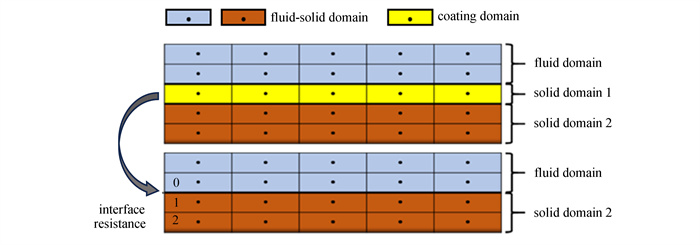
图 1 基于壳导热模型的基体-涂层系统简化传热方法原理示意图
Figure 1. The principle diagram of the simplified heat transfer method for the substrate-coating system based on the SCM

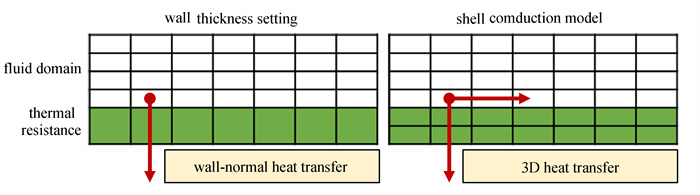
图 2 壁厚设置法和壳导热模型法的传热原理示意图
Figure 2. The Heat transfer principle diagram of the wall thickness setting method and the SCM

图 3 带涂层圆片试件几何结构示意图(单位: mm)
Figure 3. The geometric structure diagram of the coated disc specimen(unit: mm)

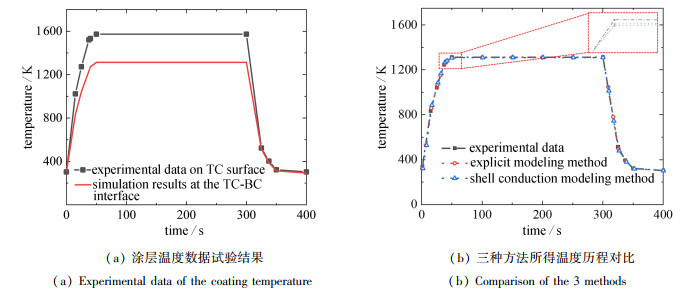
图 4 温度载荷简化分析方法的精度验证
Figure 4. Accuracy verification results of the simplified temperature load analysis method

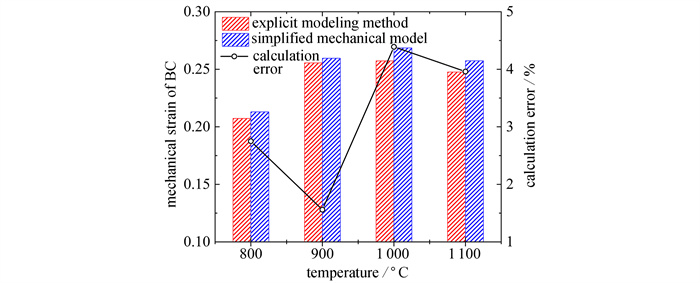
图 5 基体-涂层系统简化力学方法在不同温度下的精度验证
Figure 5. Accuracy verification of the simplified mechanical method for the substrate-coating system at different temperatures

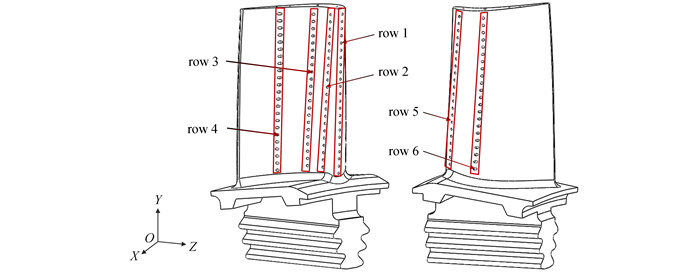
图 6 某型号航空发动机涡轮动叶简化几何模型
Figure 6. The simplified geometric model for the turbine rotor blade in a certain aero-engine

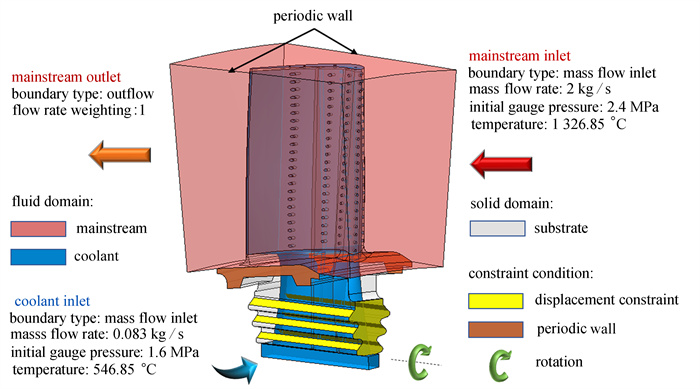
图 7 第一级涡轮动叶所施加的边界条件及约束
Figure 7. Boundary conditions and constraints of the 1st-stage turbine rotor blade

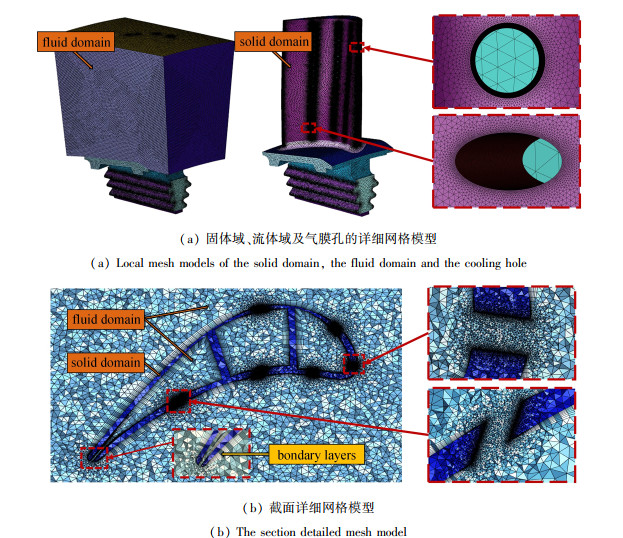
图 8 涡轮叶片及流场高质量网格模型
Figure 8. High-quality mesh model of the turbine blades and flow fields

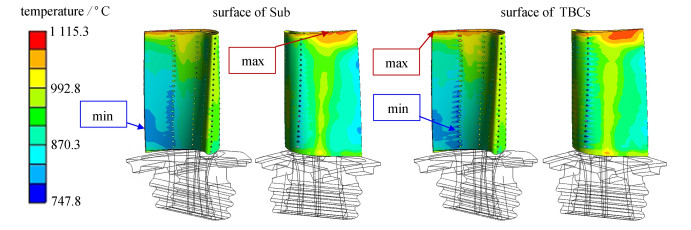
图 9 叶片基体及涂层温度载荷分布
注 为了解释图中的颜色,读者可以参考本文的电子网页版本,后同.
Figure 9. Temperature load distributions of the Sub and TBCs

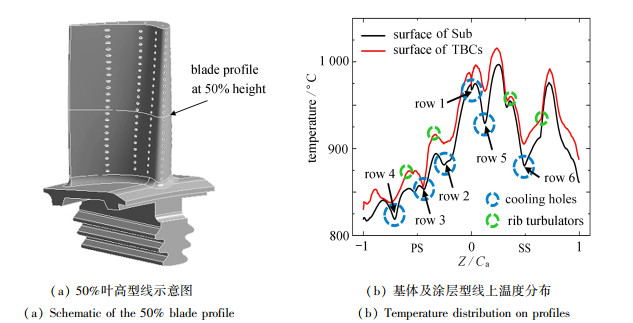
图 10 叶片基体及涂层在50%叶身型线上的温度分布
Figure 10. Temperature distributions of the Sub and TBCs at the 50% blade profile

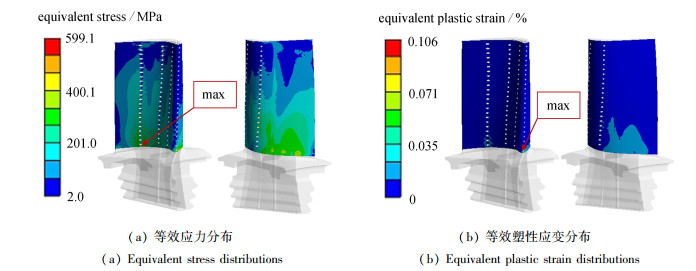
图 11 叶片基体等效应力和等效塑性应变分布
Figure 11. Equivalent stress and equivalent plastic strain distributions of the Sub

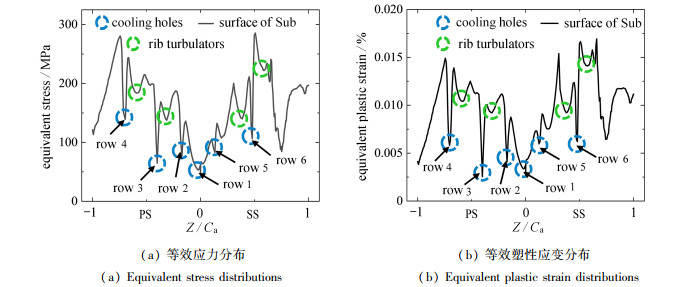
图 12 叶片基体在50%叶身型线上的等效应力和等效塑性应变分布
Figure 12. Equivalent stress and equivalent plastic strain distributions of the Sub at the 50% blade profile

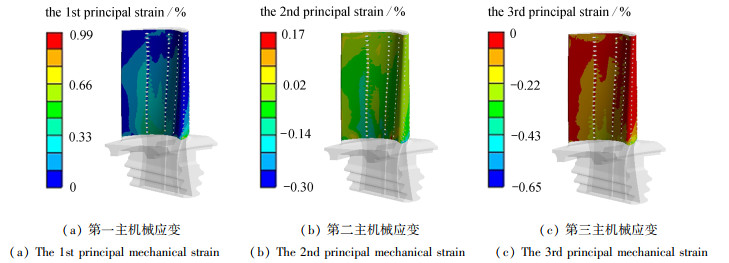
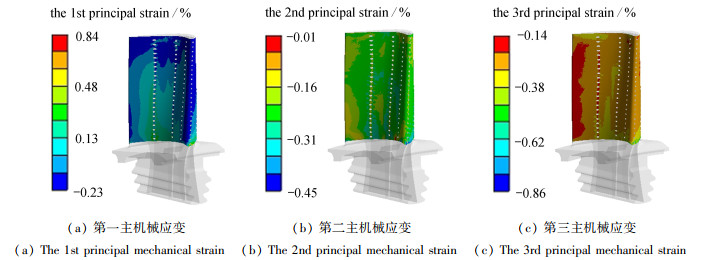
图 13 基体在三个方向的主机械应变分布
Figure 13. Mechanical strain distributions of the Sub in three principal directions

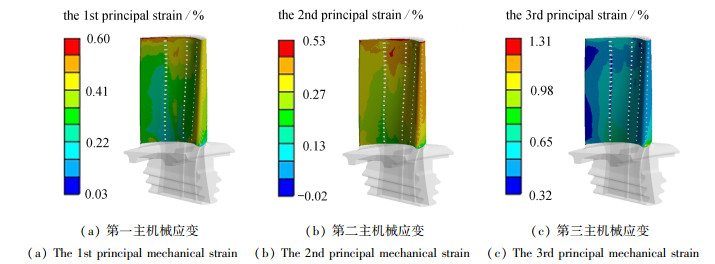
图 14 TC三个方向主机械应变分布
Figure 14. Mechanical strain distributions of the TC in three principal directions

图 15 BC三个方向主机械应变分布
Figure 15. Mechanical strain distributions of the BC in three principal directions
表 1 DD6材料在[001]方向的本构参数拟合结果
Table 1. Constitutive parameter fitting results of DD6 in the [001] direction
T/℃ C1/GPa C2/GPa C3/GPa γ1 γ2 γ3 20 5 200.0 764.4 19.2 8 568.1 8 142.8 78.5 760 458.0 440.7 58.3 1 387.5 813.3 216.4 1 100 428.1 356.0 38.9 2 352.7 2 277.2 382.5  下载: 导出CSV
表 2 相同总网格数量下,涂层实体建模方法和壳导热模型方法的最小Jacobi比率对比
Table 2. Comparison of minimum Jacobian ratios between the explicit modeling and the SCM under a similar mesh number
category explicit modeling method SCM total number of meshes 259 875 255 971 minimum Jacobian ratio 0.27 0.41
下载: 导出CSV
表 3 相同最小Jacobi比率下,涂层实体建模方法和壳导热模型方法的总网格数量和计算耗时对比
Table 3. Comparison of total mesh numbers and computation time between the explicit modeling and the SCM under the same minimum Jacobian ratio
category explicit modeling method SCM total number of meshes 259 875 49 986 minimum Jacobian ratio 0.27 0.27 computation time/h 3.5 0.3
下载: 导出CSV
parameter Sub BC TGO TC T/K 293~1 373 293~1 373 293~1 373 293~1 373 ρ/(kg·m-3) 8 780 7 380 3 980 3 610 c/(J·kg-1·K-1) 358~704 450 755 505 λ/(W·m-1·K-1) 6.70~28.95 5.80~17.00 10.00~4.40 2.40~2.10 α/(10-6·K-1) 10.5~15.8 13.6~18.1 - 9.0~10.4 E/GPa 131.5~67.5 200.0~110.0 - 48.0~22.0 ν 0.36 0.32 - 0.11
下载: 导出CSV
-
[1] PADTURE N P, GELL M, JORDAN E H. Thermal barrier coatings for gas-turbine engine applications[J]. Science, 2002, 296(5566): 280-284. doi: 10.1126/science.1068609 [2] 王铁军, 范学领, 丁秉钧, 等. 热障涂层强度理论与检测技术[M]. 西安: 西安交通大学出版社, 2016.WANG Tiejun, FAN Xueling, DING Bingjun, et al. Strength Theory and Testing Technology of Thermal Barrier Coatings[M]. Xi'an: Xi'an Jiaotong University Press, 2016. (in Chinese) [3] LIU L, FU S, HU Z, et al. Thermo-mechanical analysis of TBC-film cooling system under high blowing ratio considering the effects of curvature[J]. Surface and Coatings Technology, 2023, 470: 129826. doi: 10.1016/j.surfcoat.2023.129826 [4] 柴怡君, 林晨, 李跃明. 考虑化学氧化效应时热障涂层氧化物的生长规律[J]. 应用数学和力学, 2015, 36(4): 404-413.CHAI Yijun, LIN Chen, LI Yueming. Growth trend of thermal grown oxide in TBCs under chemical oxidation effect[J]. Applied Mathematics and Mechanics, 2015, 36(4): 404-413. (in Chinese) [5] LIU L, WU J, HU Z, et al. Thermal analysis of turbine blades with thermal barrier coatings using virtual wall thickness method[J]. Computer Modeling in Engineering & Sciences, 2023, 134(2): 1219-1236. [6] WANG X M, HUI Y Z, HOU Y Y, et al. Direct investigation on high temperature tensile and creep behavior at different regions of directional solidified cast turbine blades[J]. Mechanics of Materials, 2019, 136: 103068. doi: 10.1016/j.mechmat.2019.103068 [7] RANI S, AGRAWAL A K, RASTOGI V. Failure analysis of a first stage IN738 gas turbine blade tip cracking in a thermal power plant[J]. Case Studies in Engineering Failure Analysis, 2017, 8: 1-10. [8] CHUNG H, SOHN H S, PARK J S, et al. Thermo-structural analysis of cracks on gas turbine vane segment having multiple airfoils[J]. Energy, 2017, 118: 1275-1285. doi: 10.1016/j.energy.2016.11.005 [9] QU S, FU C M, DONG C, et al. Failure analysis of the 1st stage blades in gas turbine engine[J]. Engineering Failure Analysis, 2013, 32: 292-303. doi: 10.1016/j.engfailanal.2013.03.017 [10] KARGARNEJAD S, DJAVANROODI F. Failure assessment of Nimonic 80A gas turbine blade[J]. Engineering Failure Analysis, 2012, 26: 211-219. doi: 10.1016/j.engfailanal.2012.05.028 [11] WANG L, LI D C, YANG J S, et al. Modeling of thermal properties and failure of thermal barrier coatings with the use of finite element methods: a review[J]. Journal of the European Ceramic Society, 2016, 36(6): 1313-1331. doi: 10.1016/j.jeurceramsoc.2015.12.038 [12] WANG Z, WANG D, LIU Z, et al. Numerical analysis on effects of inlet pressure and temperature non-uniformities on aero-thermal performance of a HP turbine[J]. International Journal of Heat and Mass Transfer, 2017, 104: 83-97. doi: 10.1016/j.ijheatmasstransfer.2016.08.018 [13] MAIKELL J, BOGARD D, PIGGUSH J, et al. Experimental simulation of a film cooled turbine blade leading edge including thermal barrier coating effects[J]. Journal of Turbomachinery, 2011, 133: 011014. doi: 10.1115/1.4000537 [14] LV B, JIN X, CAO J, et al. Advances in numerical modeling of environmental barrier coating systems for gas turbines[J]. Journal of the European Ceramic Society, 2020, 40(9): 3363-3379. doi: 10.1016/j.jeurceramsoc.2020.03.036 [15] ZHU W, WANG J W, YANG L, et al. Modeling and simulation of the temperature and stress fields in a 3D turbine blade coated with thermal barrier coatings[J]. Surface and Coatings Technology, 2017, 315: 443-453. doi: 10.1016/j.surfcoat.2017.03.012 [16] JI Y, MA C, GE B, et al. Conjugate heat transfer investigation on the cooling performance of air cooled turbine blade with thermal barrier coating[J]. Journal of Thermal Science, 2016, 25(4): 325-335. doi: 10.1007/s11630-016-0867-6 [17] SHEN Q, LI S Z, YANG L, et al. Coupled mechanical-oxidation modeling during oxidation of thermal barrier coatings[J]. Computational Materials Science, 2018, 154: 538-546. doi: 10.1016/j.commatsci.2018.08.017 [18] SONG J, QI H, SHI D, et al. Effect of non-uniform growth of TGO layer on cracking behaviors in thermal barrier coatings: a numerical study[J]. Surface and Coatings Technology, 2019, 370: 113-124. doi: 10.1016/j.surfcoat.2019.04.069 [19] ZHU W, CAI M, YANG L, et al. The effect of morphology of thermally grown oxide on the stress field in a turbine blade with thermal barrier coatings[J]. Surface & Coatings Technology, 2015, 276: 160-167. [20] LI B, FAN X, LI D, et al. Design of thermal barrier coatings thickness for gas turbine blade based on finite element analysis[J]. Mathematical Problems in Engineering, 2017, 2017(1): 2147830. doi: 10.1155/2017/2147830 [21] VO D T, MAI T D, KIM B, et al. Numerical study on the influence of coolant temperature, pressure, and thermal barrier coating thickness on heat transfer in high-pressure blades[J]. International Journal of Heat and Mass Transfer, 2022, 189: 122715. doi: 10.1016/j.ijheatmasstransfer.2022.122715 [22] BALINT D, HUTCHINSON J. An analytical model of rumpling in thermal barrier coatings[J]. Journal of the Mechanics and Physics of Solids, 2005, 53(4): 949-973. doi: 10.1016/j.jmps.2004.11.002 [23] BALINT D S, KIM S S, LIU Y F, et al. Anisotropic TGO rumpling in EB-PVD thermal barrier coatings under in-phase thermomechanical loading[J]. Acta Materialia, 2011, 59(6): 2544-2555. doi: 10.1016/j.actamat.2011.01.004 [24] JIANG J, MA X, WANG B. Stress analysis of the thermal barrier coating system near a cooling hole considering the free-edge effect[J]. Ceramics International, 2020, 46(1): 331-342. doi: 10.1016/j.ceramint.2019.08.267 [25] VAUNOIS J R, DORVAUX J M, KANOUTÉ P, et al. A new version of a rumpling predictive model in thermal barrier coatings[J]. European Journal of Mechanics A, 2013, 42: 402-421. doi: 10.1016/j.euromechsol.2013.06.010 [26] DRYEPONDT S, PORTER J R, CLARKE D R. On the initiation of cyclic oxidation-induced rumpling of platinum-modified nickel aluminide coatings[J]. Acta Materialia, 2009, 57(6): 1717-1723. doi: 10.1016/j.actamat.2008.12.015 [27] TOLPYGO V, CLARKE D. On the rumpling mechanism in nickel-aluminide coatings, part Ⅱ: characterization of surface undulations and bond coat swelling[J]. Acta Materialia, 2004, 52(17): 5129-5141. [28] SMETANKINA N V, POSTNYI O V, MERKULOVA A I, et al. Modeling of non-stationary temperature fields in multilayer shells with film heat sources[C]// 2020 IEEE KhPI Week on Advanced Technology (KhPI Week). Kharkiv, Ukraine: IEEE, 2020: 242-246. [29] BERGMAN T. Fundamentals of Heat and Mass Transfer[M]. Hoboken: John Wiley & Sons, 2011. [30] LIU L, FAN X, CHU Z, et al. Thermo-mechanical loads and creep life assessment for coated turbine blades considering the influence of cooling hole blockage[J]. Engineering Failure Analysis, 2025, 170: 109321. doi: 10.1016/j.engfailanal.2025.109321 [31] TRAEGER F, VAßEN R, RAUWALD K H, et al. Thermal cycling setup for testing thermal barrier coatings[J]. Advanced Engineering Materials, 2003, 5(6): 429-432. doi: 10.1002/adem.200300337 [32] EVANS H E. Oxidation failure of TBC systems: an assessment of mechanisms[J]. Surface and Coatings Technology, 2011, 206(7): 1512-1521. doi: 10.1016/j.surfcoat.2011.05.053 [33] 中国金属学会高温材料分会. 中国高温合金手册[M]. 北京: 中国标准出版社, 2012.The High Temperature Materials Branch of The Chinese Society for Metals. China Superalloys Handbook[M]. Beijing: Standards Press of China, 2012. (in Chinese) [34] CAI L, HE Y, WANG S, et al. Thermal-fluid-solid coupling analysis on the temperature and thermal stress field of a nickel-base superalloy turbine blade[J]. Materials, 2021, 14(12): 3315. doi: 10.3390/ma14123315 -


计量
- 文章访问数: 113
- HTML全文浏览量: 43
- PDF下载量: 23
- 被引次数: 0

 渝公网安备50010802005915号