


Effects of Fracture Characteristics of Cross-Linking Proteins on the Mechanical Responses of Actin-Microtubule Composite Networks
-
摘要: 细胞骨架的力学性能对维持细胞形态、实现细胞运动与分裂等生命过程至关重要. 肌动蛋白丝与微管作为细胞骨架的核心组分,通过交联蛋白相互连接,形成复杂的聚合物网络结构,其宏观力学行为与交联蛋白的物理特性密切相关. 本研究基于粗粒化肌动蛋白-微管复合网络模型,系统探究了交联蛋白的断裂距离阈值与生成距离阈值两个关键参数对网络力学性能的影响. 模拟结果表明:微管交联蛋白的断裂距离阈值对网络的力学响应起着主导作用;减小其断裂距离阈值会导致应力-应变曲线整体向下移动,结构承载能力降低. 相比之下,肌动蛋白丝交联蛋白断裂距离阈值的变化对复合网络宏观力学响应影响微弱. 此外,交联蛋白的生成距离阈值对网络力学性能影响不显著. 本研究揭示了肌动蛋白-微管复合网络的宏观力学性能主要由交联蛋白断裂距离阈值决定,而对生成距离阈值不敏感,为理解动态交联对细胞骨架的力学稳定性提供了新的理解视角.
-
关键词:
- 肌动蛋白-微管复合网络 /
- 动态交联 /
- 断裂距离 /
- 生成距离
Abstract: The mechanical properties of the cytoskeleton are crucial for maintaining cell morphology and enabling life processes such as cell movement and division. Actin filaments and microtubules, as core components of the cytoskeleton, are interconnected by cross-linking proteins to form a complex polymer network structure, of which the macroscopic mechanical behavior is closely related to the physical properties of cross-linking proteins. Based on a coarse-grained actin-microtubule composite network model, the effects of 2 key parameters of cross-linking proteins: the fracture distance threshold and the formation distance threshold, on the network's mechanical properties were systematically investigated. The simulation results show that, the fracture distance threshold of microtubule cross-linking proteins plays a dominant role in the network's mechanical responses: reducing this threshold leads to an overall downward shift of the stress-strain curve and a decrease in structural loading-bearing capacity. In contrast, changes in the fracture distance threshold of actin filament cross-linking proteins have a weak impact on the macroscopic mechanical behavior, and the formation distance threshold of cross-linking proteins has no significant effect on the network's mechanical properties. This study reveals that the macroscopic mechanical properties of the actin-microtubule composite network are mainly dependent on the fracture distance threshold of cross-linking proteins while being insensitive to the formation distance threshold, providing a new sight for understanding the role of dynamic cross-linking in the mechanical stability of the cytoskeleton. -

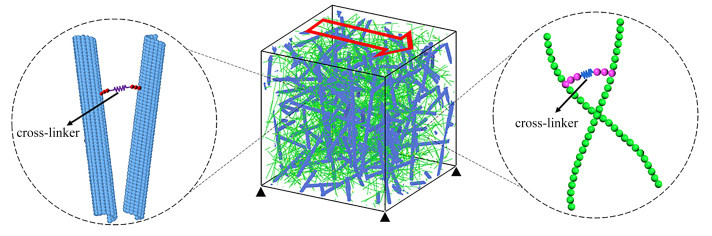
图 1 肌动蛋白-微管复合网络粗粒化计算模型
注 为了解释图中的颜色,读者可以参考本文的电子网页版本,后同.
Figure 1. The coarse-grained computational model for actin-microtubule composite networks

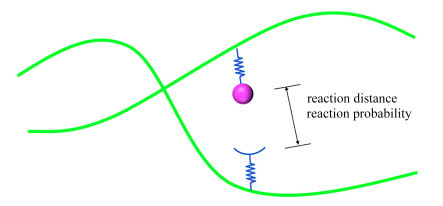
图 2 交联蛋白动态作用示意图
Figure 2. Schematic diagram of the dynamic action of cross-linking proteins

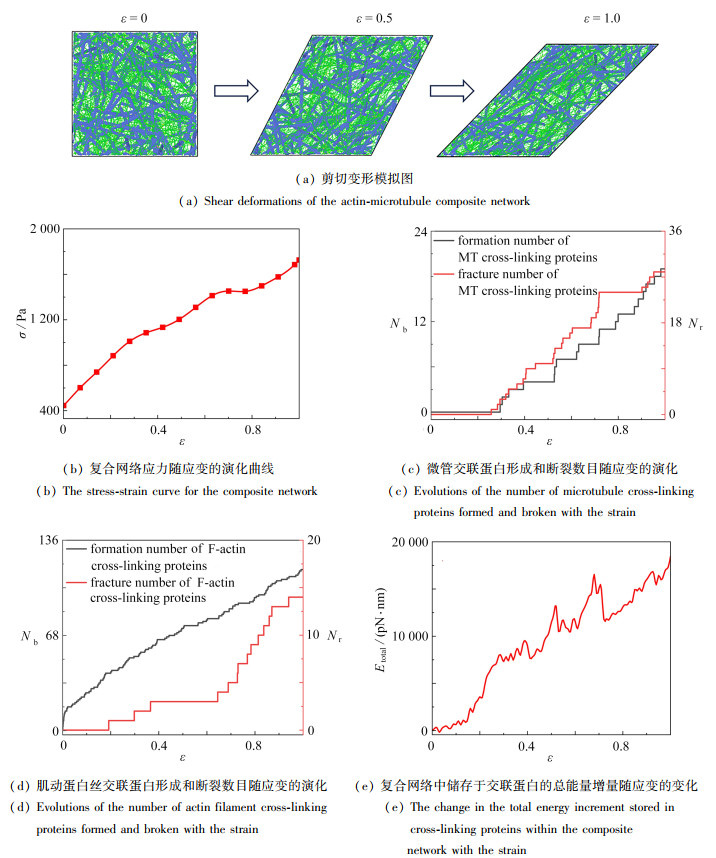
图 3 肌动蛋白-微管复合网络力学性能分析(应力-应变、交联蛋白数目及能量增量演化)
Figure 3. Mechanical property analysis of actin-microtubule composite networks(stress-strain, evolution of cross-linking protein number, and energy increments)

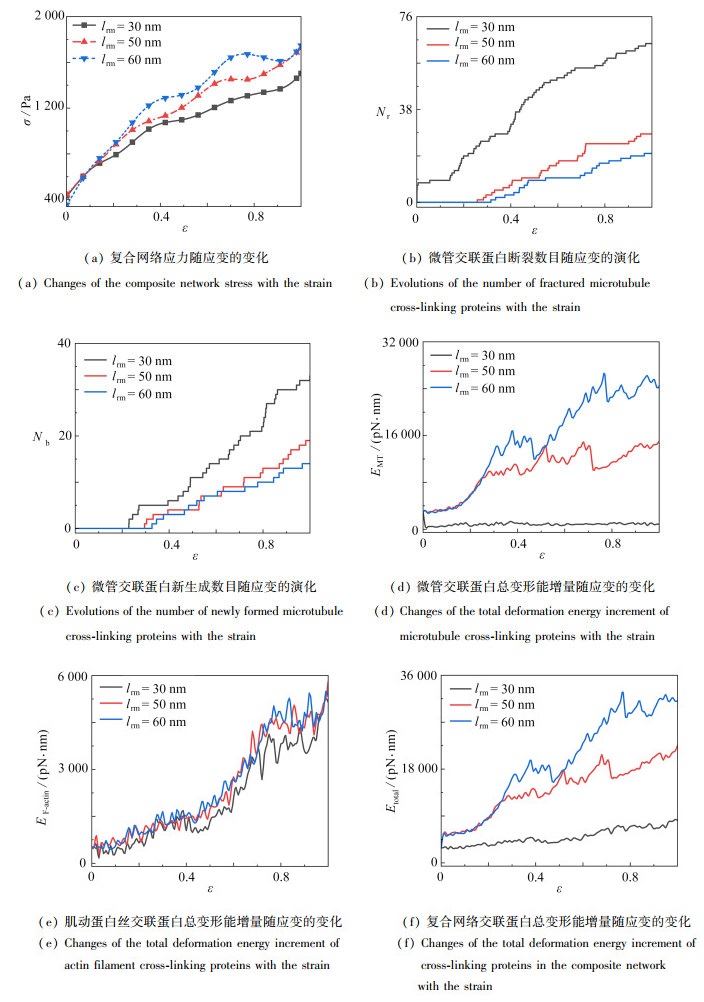
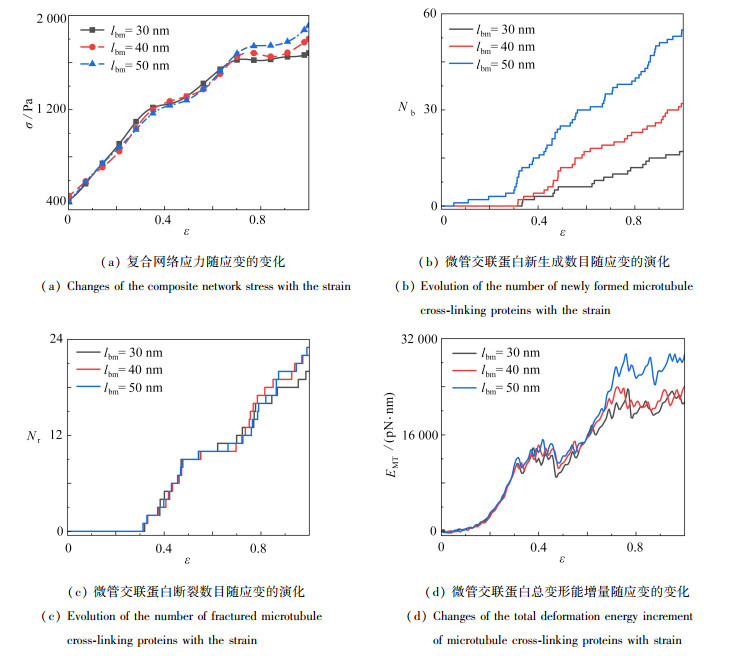
图 4 微管交联蛋白不同断裂距离阈值对复合网络力学响应的影响
Figure 4. Effects of different breaking distance thresholds of microtubule crosslinking proteins on the mechanical response of actin-microtubule composite network

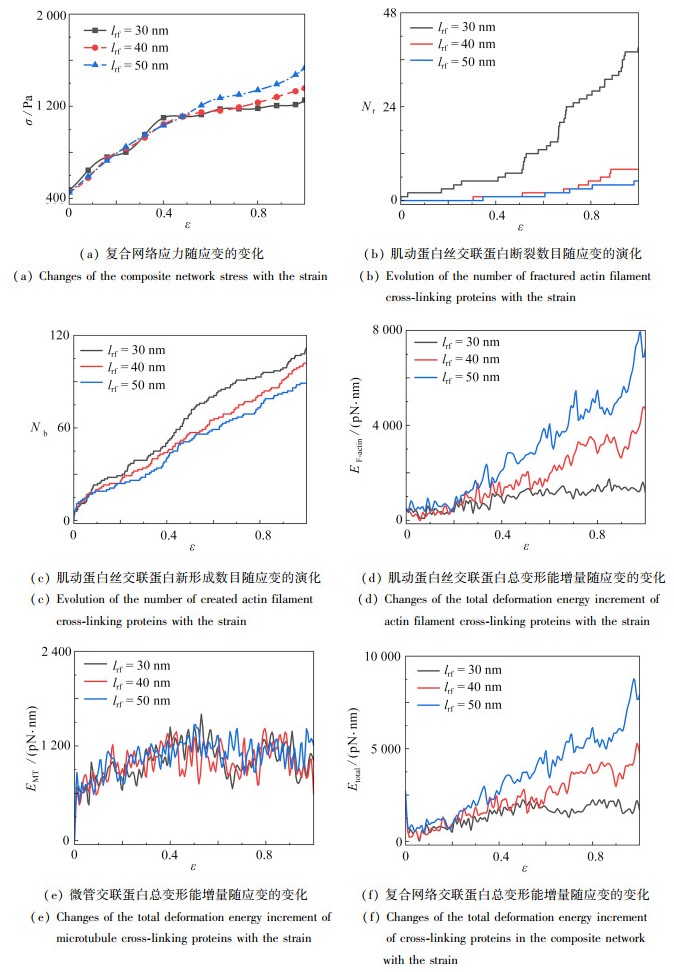
图 5 肌动蛋白丝交联蛋白不同断裂距离阈值下复合网络力学响应随应变的变化
Figure 5. Mechanical responses of the composite network to strains under different fracture distance thresholds of actin filament cross-linking proteins

图 6 微管交联蛋白不同生成距离阈值下复合网络力学响应随应变的变化
Figure 6. Mechanical responses of the composite network to strains under different formation distance thresholds of microtubule cross-linking proteins

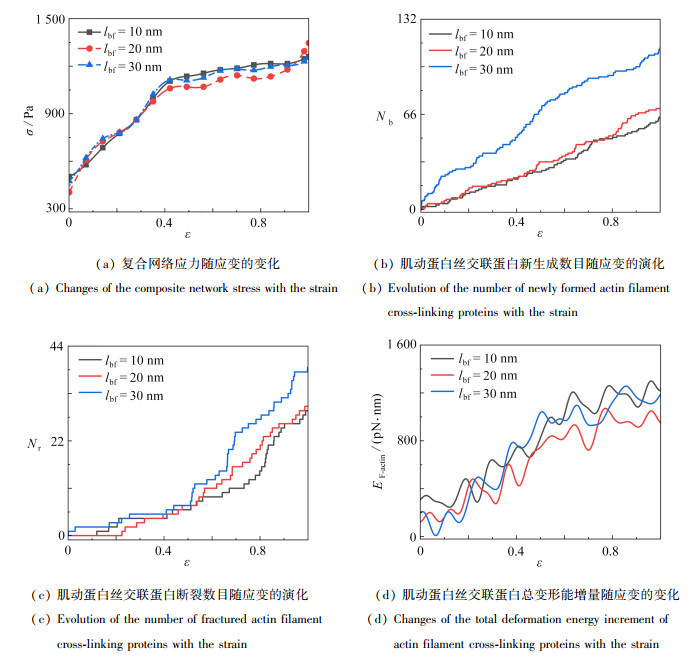
图 7 肌动蛋白丝交联蛋白不同生成距离阈值对复合网络力学性能的影响
Figure 7. Effects of different formation distance thresholds of actin filament crosslinking proteins on the mechanical properties of the composite network

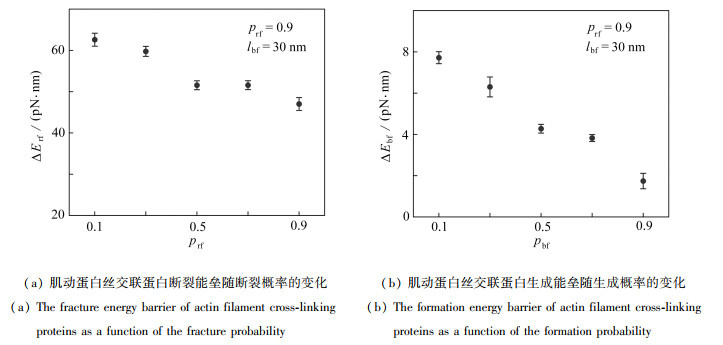
图 8 交联蛋白断裂和生成概率与能垒之间的对应关系(图中每个能垒点代表 10组计算结果的平均值)
Figure 8. Correspondence between the fracture and formation probabilities of cross-linking proteins and energy barriers (each energy barrier point in the figure represents the average value of 10 sets of calculation results)

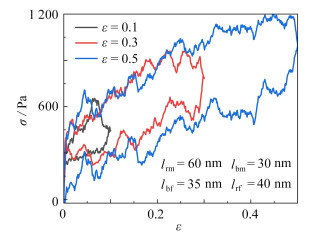
图 9 三次独立的加载-卸载条件下复合网络的力学响应
Figure 9. Mechanical responses of the composite network under 3 independent loading and unloading conditions
表 1 模拟参数列表
Table 1. Simulation parameters
parameter physical meaning unit pbf formation probability of microtubule cross-linking proteins prm fracture probability of microtubule cross-linking proteins pbf formation probability of actin filament cross-linking proteins prf fracture probability of actin filament cross-linking proteins lbf distance threshold for the formation of actin filament cross-linking proteins nm lrf fracture distance threshold for actin filament cross-linking proteins nm lbf formation distance threshold for microtubule cross-linking proteins nm lrm fracture distance threshold for microtubule cross-linking proteins nm ε shear strain σ shear stress Pa Nb number of cross-linking proteins formed with strain Nr number of cross-linking proteins ruptured with strain EF-actin bond energy increment of cross-linking proteins of the actin filament network pN·nm EMT bond energy increment of cross-linking proteins of the microtubule network pN·nm Etotal bond energy increment of cross-linking proteins of the composite network pN·nm ΔEbf formation energy barrier of actin filament cross-linking proteins pN·nm ΔErf fracture energy barrier of actin filament cross-linking proteins pN·nm  下载: 导出CSV
表 2 微管与肌动蛋白丝交联蛋白断裂距离阈值取值表
Table 2. The fracture distance thresholds for microtubule and F-actin cross-linking proteins
fiber type fixed parameter variable parameter values of fracture distance thresholds of crosslinkers fracture force crosponding to fracture distance thresholds of cross-linkers microtubule prm=prf=pbf=pbf=0.05,lbf=35 nm,lbf=30 nm,lrf=40 nm lrm 30 nm,50 nm,60 nm 10 pN,30 pN,40 pN actin filament prm=prf=pbf=pbf=0.05,lbf=30 nm,lbf=30 nm,lrm=30 nm lrf 30 nm,40 nm,50 nm 10 pN,20 pN,40 pN
下载: 导出CSV
表 3 微管与肌动蛋白丝交联蛋白生成距离阈值取值表
Table 3. The formation distance thresholds for microtubule and F-actin cross-linking proteins
fibertype fixed parameter variable parameter values of the formation distance thresholds of cross-linkers microtubule prm=prf=pbf=pbf=0.05,lbf=35 nm,lrm=60 nm,lrf=40 nm lbf 30 nm,40 nm,50 nm actin filament prm=prf=pbf=pbf=0.05,lrf=30 nm,lbf=30 nm,lrm=30 nm lbf 10 nm,20 nm,30 nm
下载: 导出CSV
-
[1] DOGTEROM M, KOENDERINK G H. Actin-microtubule crosstalk in cell biology[J]. Nature Reviews Molecular Cell Biology, 2019, 20(1): 38-54 doi: 10.1038/s41580-018-0067-1 [2] WEN Q, JANMEY P A. Polymer physics of the cytoskeleton[J]. Current Opinion in Solid State and Materials Science, 2011, 15(5): 177-182. doi: 10.1016/j.cossms.2011.05.002 [3] HUBER F, BOIRE A, LÓPEZ M P, et al. Cytoskeletal crosstalk: when three different personalities team up[J]. Current Opinion in Cell Biology, 2015, 32: 39-47. doi: 10.1016/j.ceb.2014.10.005 [4] LEE W. The cytoskeleton and its binding proteins as mechanosensors, transducers, and functional regulators of cells[J]. International Journal of Molecular Sciences, 2023, 25(1): 172. doi: 10.3390/ijms25010172 [5] HANG J T, XU G K. Stiffening and softening in the power-law rheological behaviors of cells[J]. Journal of the Mechanics and Physics of Solids, 2022, 167: 104989. doi: 10.1016/j.jmps.2022.104989 [6] WANG H, HANG J T, CHANG Z, et al. Static and dynamic mechanics of cell monolayers: a multi-scale structural model[J]. Acta Mechanica Sinica, 2022, 38(5): 222006. doi: 10.1007/s10409-022-22006-x [7] HANG J T, KANG Y, XU G K, et al. A hierarchical cellular structural model to unravel the universal power-law rheological behavior of living cells[J]. Nature Communications, 2021, 12: 6067. doi: 10.1038/s41467-021-26283-y [8] MCGARRY J G, PRENDERGAST P J. A three-dimensional finite element model of an adherent eukaryotic cell[J]. European Cells and Materials, 2004, 7: 27-34. doi: 10.22203/eCM.v007a03 [9] WANG L, WANG L, XU L, et al. Finite element modelling of single cell based on atomic force microscope indentation method[J]. Computational and Mathematical Methods in Medicine, 2019, 2019(1): 7895061. [10] ZHANG L Y, LI Y, CAO Y P, et al. Stiffness matrix based form-finding method of tensegrity structures[J]. Engineering Structures, 2014, 58: 36-48. doi: 10.1016/j.engstruct.2013.10.014 [11] LIN Y C, KOENDERINK G H, MACKINTOSH F C, et al. Control of non-linear elasticity in F-actin networks with microtubules[J]. Soft Matter, 2011, 7(3): 902-906. doi: 10.1039/C0SM00478B [12] LIANG D, HANG J T, XU G K. A structure-based cellular model reveals power-law rheology and stiffening of living cells under shear stress[J]. Acta Mechanica Sinica, 2023, 39(10): 623129. doi: 10.1007/s10409-023-23129-x [13] KIM T, HWANG W, KAMM R D. Dynamic role of cross-linking proteins in actin rheology[J]. Biophysical Journal, 2011, 101(7): 1597-1603. doi: 10.1016/j.bpj.2011.08.033 [14] KOLE T P, TSENG Y, JIANG I, et al. Intracellular mechanics of migrating fibroblasts[J]. Molecular Biology of the Cell, 2005, 16(1): 328-338. doi: 10.1091/mbc.e04-06-0485 [15] FISCHER-FRIEDRICH E, TOYODA Y, CATTIN C J, et al. Rheology of the active cell cortex in mitosis[J]. Biophysical Journal, 2016, 111(3): 589-600. doi: 10.1016/j.bpj.2016.06.008 [16] CHAUBET L, CHAUDHARY A R, HERIS H K, et al. Dynamic actin cross-linking governs the cytoplasm's transition to fluid-like behavior[J]. Molecular Biology of the Cell, 2020, 31(16): 1744-1752. doi: 10.1091/mbc.E19-09-0504 [17] KUČERA O, GAILLARD J, GUÉRIN C, et al. Actin-microtubule dynamic composite forms responsive active matter with memory[J]. Proceedings of the National Academy of Sciences of the United States of America, 2022, 119(31): e2209522119. [18] HANG J T, WANG H, WANG B C, et al. Anisotropic power-law viscoelasticity of living cells is dominated by cytoskeletal network structure[J]. Acta Biomaterialia, 2024, 180: 197-205. doi: 10.1016/j.actbio.2024.04.002 [19] LI S H, XU G K. Topological mechanism in the nonlinear power-law relaxation of cell cortex[J]. Physical Review E, 2023, 108(6): 064408. [20] ZHOU W H, YIN X, XIE S J, et al. A tensegrity-based mechanochemical model for capturing cell oscillation and reorientation[J]. Journal of Applied Physics, 2024, 136(7): 074701. doi: 10.1063/5.0226910 [21] RICKETTS S N, FRANCIS M L, FARHADI L, et al. Varying crosslinking motifs drive the mesoscale mechanics of actin-microtubule composites[J]. Scientific Reports, 2019, 9: 12831. doi: 10.1038/s41598-019-49236-4 [22] RICKETTS S N, ROSS J L, ROBERTSON-ANDERSON R M. Co-entangled actin-microtubule composites exhibit tunable stiffness and power-law stress relaxation[J]. Biophysical Journal, 2018, 115(6): 1055-1067. doi: 10.1016/j.bpj.2018.08.010 [23] FRANCIS M L, RICKETTS S N, FARHADIL, et al. Non-monotonic dependence of stiffness on actin crosslinking in cytoskeleton composites[J]. Soft Matter, 2019, 15(44): 9056-9065. doi: 10.1039/C9SM01550G [24] DWYER M E, ROBERTSON-ANDERSON R M, GURMESSA B J. Nonlinear microscale mechanics of actin networks governed by coupling of filament crosslinking and stabilization[J]. Polymers, 2022, 14(22): 4980. doi: 10.3390/polym14224980 [25] MAXIAN O, PELÁEZ R P, MOGILNER A, et al. Simulations of dynamically cross-linked actin networks: morphology, rheology, and hydrodynamic interactions[J]. PLoS Computational Biology, 2021, 17(12): e1009240. doi: 10.1371/journal.pcbi.1009240 [26] ZHANG B, GONG Z, ZHAO L, et al. Decoding protein dynamics in cells using chemicalcross-linking and hierarchical analysis[J]. Angewandte Chemie International Edition, 2023, 62(35): e202301345. doi: 10.1002/anie.202301345 [27] LI L, HOU Z. Crosslink-induced conformation change of intrinsically disordered proteins have a nontrivial effect on phase separation dynamics and thermodynamics[J]. The Journal of Physical Chemistry B, 2023, 127(22): 5018-5026. doi: 10.1021/acs.jpcb.3c01728 [28] XU J, WIRTZ D, POLLARD T D. Dynamic cross-linking by α-actinin determines the mechanical properties of actin filament networks[J]. Journal of Biological Chemistry, 1998, 273(16): 9570-9576. doi: 10.1074/jbc.273.16.9570 [29] FREEDMAN S L, BANERJEE S, HOCKY G M, et al. A versatile framework for simulating the dynamic mechanical structure of cytoskeletal networks[J]. Biophysical Journal, 2017, 113(2): 448-460. doi: 10.1016/j.bpj.2017.06.003 [30] ZHA J, ZHANG Y, XIA K, et al. Coarse-grained simulation of mechanical properties of single microtubules with micrometer length[J]. Frontiers in Molecular Biosciences, 2021, 7: 632122. doi: 10.3389/fmolb.2020.632122 [31] CHU J W, VOTH G A. Coarse-grained modeling of the actin filament derived from atomistic-scale simulations[J]. Biophysical Journal, 2006, 90(5): 1572-1582. doi: 10.1529/biophysj.105.073924 [32] WANG Z, YUAN L, XU W, et al. Mechanical behaviors of actin-microtubule composite network: a coarse-grained Langevin dynamics study[J]. Acta Mechanica Sinica, 2025, 42(4): 624674. [33] STUKOWSKI A. Visualization and analysis of atomistic simulation data with OVITO: the open visualization tool[J]. Modelling and Simulation in Materials Science and Engineering, 2010, 18(1): 015012. doi: 10.1088/0965-0393/18/1/015012 [34] BRANGWYNNE C P, MACKINTOSH F C, KUMAR S, et al. Microtubules can bear enhanced compressive loads in living cells because of lateral reinforcement[J]. The Journal of Cell Biology, 2006, 173(5): 733-741. doi: 10.1083/jcb.200601060 [35] GARDEL M L, NAKAMURA F, HARTWIG J, et al. Stress-dependent elasticity of composite actin networks as a model for cell behavior[J]. Physical Review Letters, 2006, 96(8): 088102. doi: 10.1103/PhysRevLett.96.088102 [36] POLLARD T D. Actin and actin-binding proteins[J]. Cold Spring Harbor Perspectives in Biology, 2016, 8(8): a018226. doi: 10.1101/cshperspect.a018226 [37] LIELEG O, SCHMOLLER K M, CLAESSENS M M A E, et al. Cytoskeletal polymer networks: viscoelastic properties are determined by the microscopic interaction potential of cross-links[J]. Biophysical Journal, 2009, 96(11): 4725-4732. doi: 10.1016/j.bpj.2009.03.038 [38] SEMMRICH C, LARSEN R J, BAUSCH A R. Nonlinear mechanics of entangled F-actin solutions[J]. Soft Matter, 2008, 4(8): 1675-1680. doi: 10.1039/b800989a [39] TANG B, SUN F, WEI X, et al. Defect size and cross-linkerproperties controlled fracture of biopolymer networks[J]. Extreme Mechanics Letters, 2022, 54: 101743. doi: 10.1016/j.eml.2022.101743 [40] WEI X, FANG C, GONG B, et al. Viscoelasticity of 3D actin networks dictated by the mechanochemical characteristics of cross-linkers[J]. Soft Matter, 2021, 17(45): 10177-10185. doi: 10.1039/D0SM01558J [41] HUISMAN E M, VAN DILLEN T, ONCK P R, et al. Three-dimensional cross-linked F-actin networks: relation between network architecture and mechanical behavior[J]. Physical Review Letters, 2007, 99(20): 208103. doi: 10.1103/PhysRevLett.99.208103 [42] WEI X, FANG C, GONG B, et al. Time-dependent response of bio-polymer networks regulated by catch and slip bond-like kinetics of cross-linkers[J]. Journal of the Mechanics and Physics of Solids, 2021, 147: 104267. doi: 10.1016/j.jmps.2020.104267 [43] LI S H, GAO H, XU G K. Network dynamics of the nonlinear power-law relaxation of cell cortex[J]. Biophysical Journal, 2022, 121(21): 4091-4098. doi: 10.1016/j.bpj.2022.09.035 -

计量
- 文章访问数: 107
- HTML全文浏览量: 40
- PDF下载量: 20
- 被引次数: 0

 渝公网安备50010802005915号